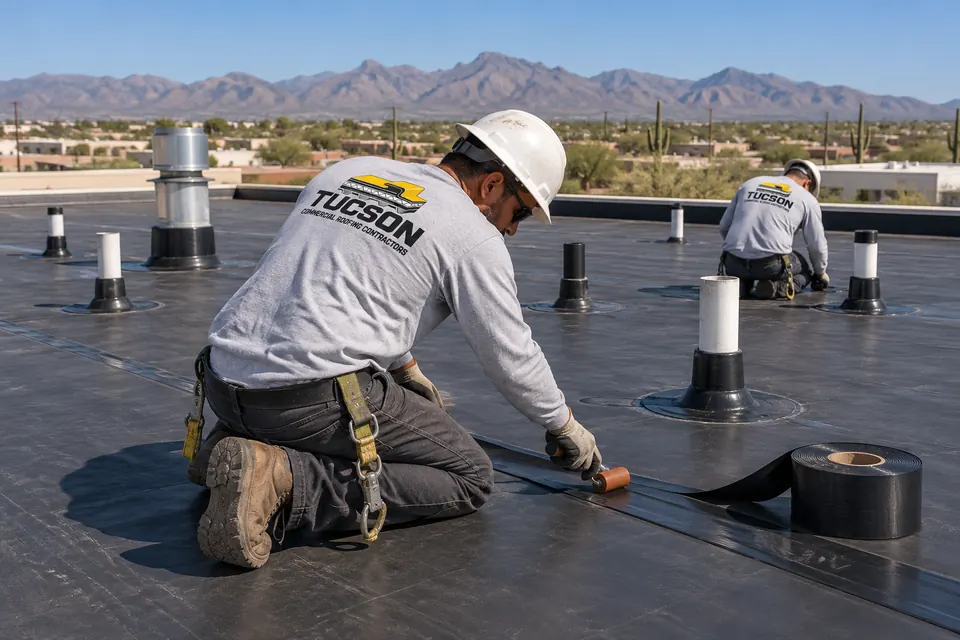
EPDM Roofing
A mechanical penthouse or a roof section crowded with pipes is easier to flash in flexible EPDM, so some buildings mix the two systems.

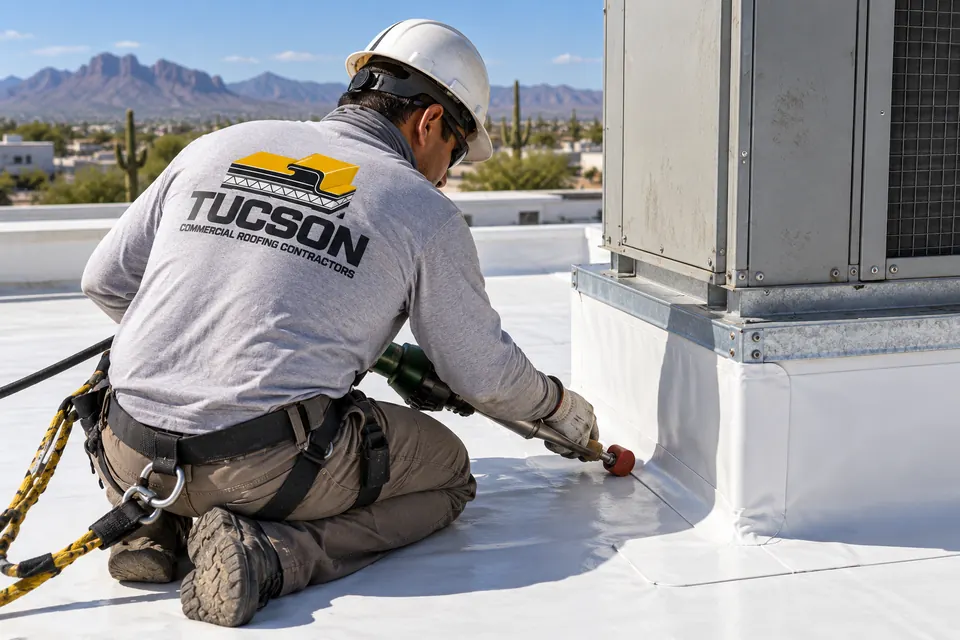
As a TPO roofing contractor in Tucson, we install, replace, and repair white TPO roofs with heat-welded seams on retail, office, medical, and warehouse buildings.
TPO works best on a low-slope roof that drains and sits over air-conditioned space. The second column lists the roofs where another system serves better.
These are the conditions we find most on older TPO roofs around Tucson, sorted by urgency.
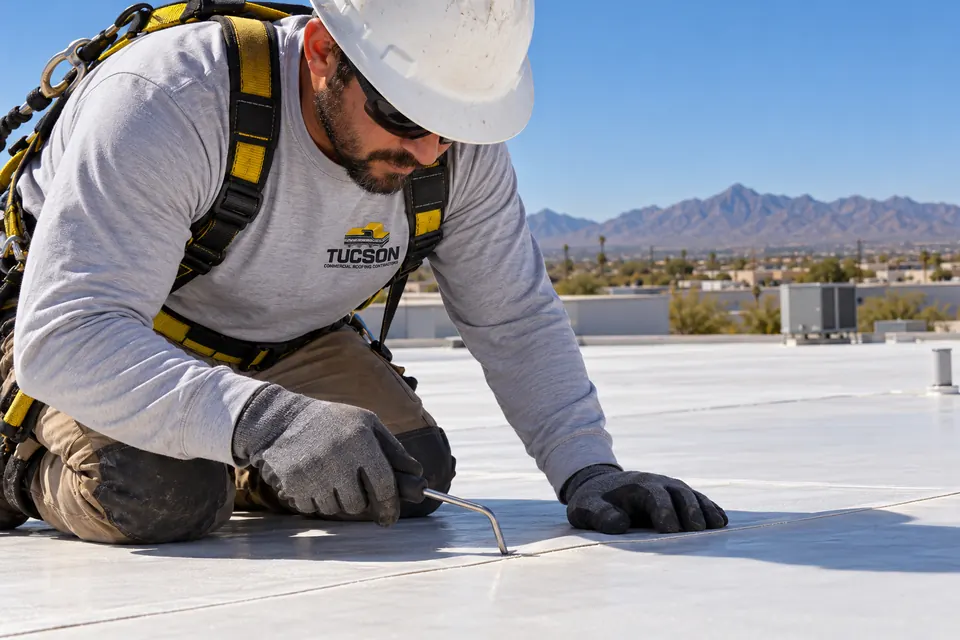
A probe slides into a lap where the weld was too cold or too narrow. Wind-driven monsoon rain finds those gaps first.
Older sheets shrink and tug at curb corners and wall flashing, stretching the TPO until it splits at the inside corner.
Technicians walking to rooftop units drop screws and drag tools. Small punctures line the path between the hatch and each unit.
Water left standing after a storm marks a low spot or an undersized drain, and dirt rings show where it sits.
Boots around vent pipes crack in the sun. A boot split at the top lets rain run straight down the pipe into the ceiling.
Spongy spots mean wet insulation under the membrane. Left alone, the wet area spreads and the board loses its grip on the deck.
Four ways a TPO job can go. The core cut and the drainage check point to one of them.
| Option | When it fits | What the work includes |
|---|---|---|
| Targeted repair | A few open welds, boots, or curbs on a roof with dry insulation | New welded patches, rewelded laps, new pipe boots and curb wraps |
| TPO recover | Old roof is dry and flat-lying, with room under the code limit for another layer | Cover board over the old roof, new TPO welded on top, new edge metal |
| Tear-off and replace | Wet insulation, a soft deck, or an existing recover already on the roof | Removal to the deck, deck repairs, new insulation, cover board, and TPO |
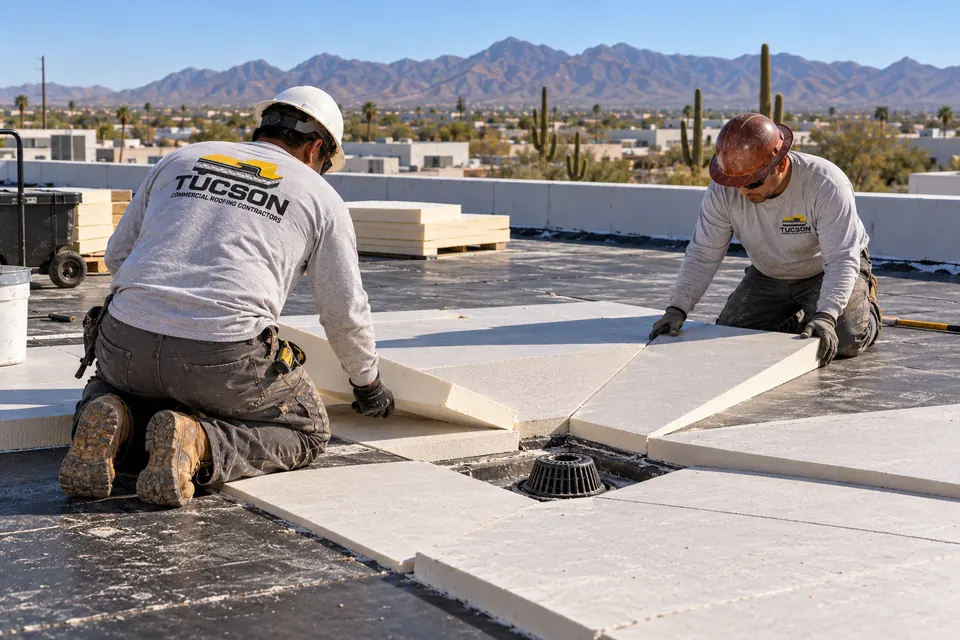
| Replace with tapered insulation | Water ponds at drains or along walls after storms | Tapered boards and crickets set toward drains, plus overflow scuppers |
Each row starts with a failure we see on older Tucson roofs and shows what a new TPO roof does about it.
Laps held by adhesive or tape soften in summer heat and peel open when monsoon wind drives rain sideways.
Hot-air welds fuse the sheets into one piece, so the lap is as strong as the membrane around it.
Black or gravel roofs soak up sun all afternoon and push that heat down into the offices or store below.
White TPO reflects much of the sun, and CRRC-rated sheets can qualify for utility cool roof programs when they are offered.
Pitch pans and caulked flashing around rooftop units crack after a few summers of heat and vibration.
Curbs and supports get TPO flashing welded to the field sheet, with walk pads laid on the service paths.
Roofs built dead flat hold water at the drains, and every pond shortens the life of the sheet under it.
Replacement adds tapered insulation and crickets, so the new membrane sheds water instead of sitting under it.
Call and describe where the leak shows inside and which unit sits above it. That tells us which curb and seams to check first.
Six steps from the first roof walk to the last weld check, run so each section is closed before afternoon storms.
Seams, curbs, boots, drains, and edges are checked across the full surface, and every open lap and puncture is marked on a roof plan.
A core shows the layers down to the deck. Meter readings across the field map wet insulation that has to come out.
Low spots and drain locations set the taper plan, and crickets go behind curbs and along walls where water stalls today.
Old roofing comes off one section at a time. Deck repairs, insulation, and cover board go down before that section closes for the night.
Sheets are fastened or adhered, field seams welded with a hot-air welder, and curbs, walls, and pipe boots flashed in matching TPO.
All field seams and flashings get probed, drains are cleared of scrap, and walk pads are set on paths to the rooftop units.
Some buildings need a second system on part of the roof. These two pair most often with TPO.
A mechanical penthouse or a roof section crowded with pipes is easier to flash in flexible EPDM, so some buildings mix the two systems.
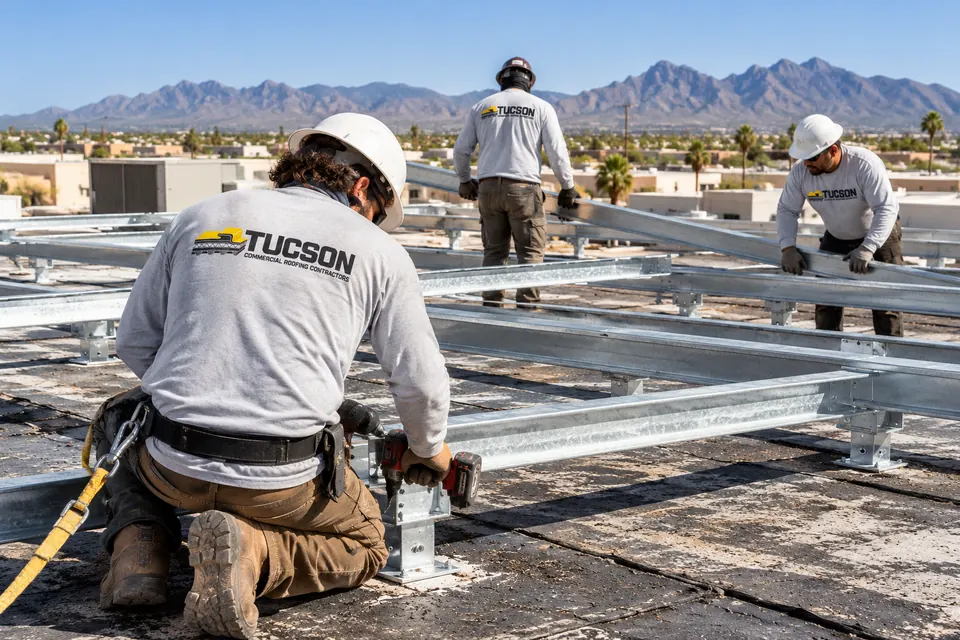
Where a flat roof has no room for drains, a metal retrofit frame adds slope and sheds monsoon water off the edge.
Welded seams are the reason TPO holds up in wind-driven monsoon rain: there is no glued lap for water to work into. The sheet still needs a roof that drains, so drain size and tapered insulation get as much attention as the membrane.
White TPO reflects much more sun than a dark roof, so less heat reaches the roof deck. How much that changes a cooling bill depends on insulation, the HVAC system, and the building, so we avoid promising a number.
Thicker sheets carry more material over the reinforcing scrim and handle foot traffic and hail better. Thickness gets matched to the roof: heavy service traffic and long ownership point to a thicker sheet.
Often, yes. A recover works when the core cut shows dry insulation and the roof has only one existing layer. A cover board goes over the old surface first, and wet areas get cut out and replaced.
Units stay in place in most jobs. Curbs get new TPO flashing welded to the field sheet, and when a curb is too short for the new insulation height, the mechanical contractor raises the unit first.
Usually. Older TPO is cleaned and prepared so a new patch welds to it. Very weathered sheets accept welds poorly, and a failed test weld is one sign the roof is near replacement.
Repeat leaks usually trace to a curb corner, a pipe boot, or a lap that was patched without being rewelded. Water can also travel under the sheet, so the opening sits several feet from the stain.
Tell us the roof size and what is happening inside, and we will inspect the welds, curbs, and drains.
Leave a name and number, and we will call you back about the roof.