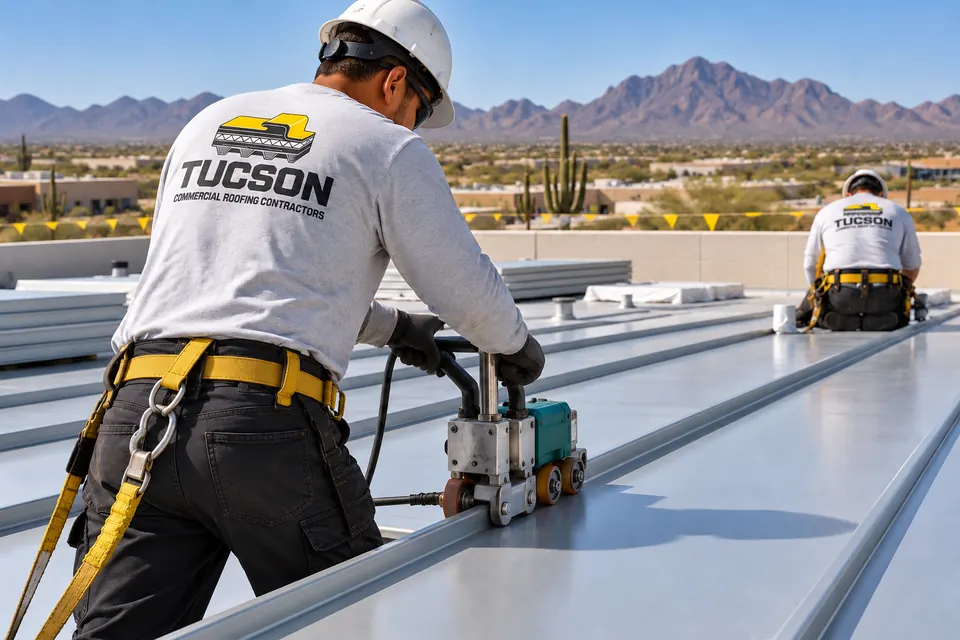
Commercial Metal Roofing
Process buildings and long-hold owners often choose standing seam metal for its long service life and fewer leak points.

Our industrial roofing contractor work in Tucson covers manufacturing plants, aerospace and tech buildings, distribution centers, and mining-support facilities, with roofs replaced in phases around operations.
Size alone does not make a roof industrial. Equipment, exhaust, and operations below the deck do.
Plants and distribution buildings wear their roofs differently from offices. These are the signs we look for first.
Oily or chemical exhaust softens and discolors some membranes around fans and stacks, and blisters form at the edge of the stained area.
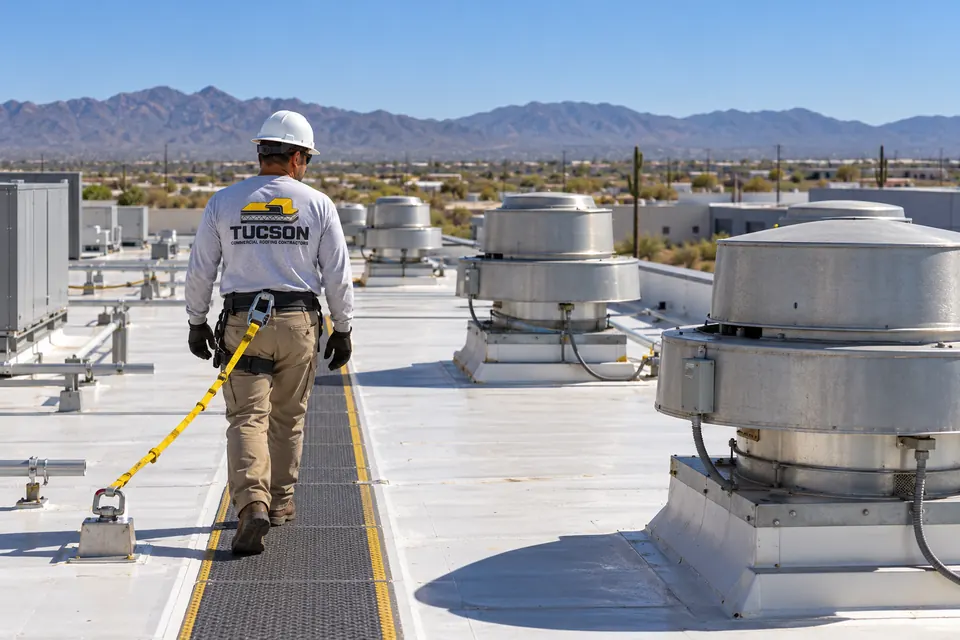
Maintenance crews crossing the roof to fans and air handlers wear through the surface where no walk pads were laid.
Water dripping onto machinery, product, or electrical panels during a storm means a curb or penetration above is open now.
Pipe and duct supports that rock or have worn through their pads cut into the membrane each time the equipment vibrates.
Large units block water on the upslope side, leaving ponds that soak the membrane at the curb base.
Long perimeter runs catch monsoon microbursts. One loose section of edge metal can let wind peel back a large area of roof.
Industrial roofs use the same systems as other commercial roofs, adjusted for equipment, exhaust, and operations.
| Option | When it fits | What the work includes |
|---|---|---|
| Phased TPO replacement | Large low-slope roof over plants or distribution space | Sections replaced in order, each closed at day end, curbs rebuilt |
| EPDM near crowded equipment | Roof areas packed with pipes, ducts, and supports | Flexible flashing around penetrations, reinforced areas at supports |
| Metal roof or retrofit | Process buildings, shops, and long-term owners | Standing seam panels, or retrofit framing that adds slope over a flat roof |
| Repair and walk-path program | Roof in fair shape but worn by maintenance traffic | Repairs at curbs and supports, walk pads, and scheduled inspections |
Each row starts with a failure common on Tucson plant and warehouse roofs and what the new roof changes.
A membrane picked without checking exhaust softens near vents and stacks within a few years.
The new sheet is matched to what the stacks vent, with extra protection in the areas the exhaust reaches.
Unplanned foot traffic to equipment scuffs and punctures the roof on the same routes every week.
Reinforced membrane and walk pads mark the routes to each unit, so traffic stays on protected paths.
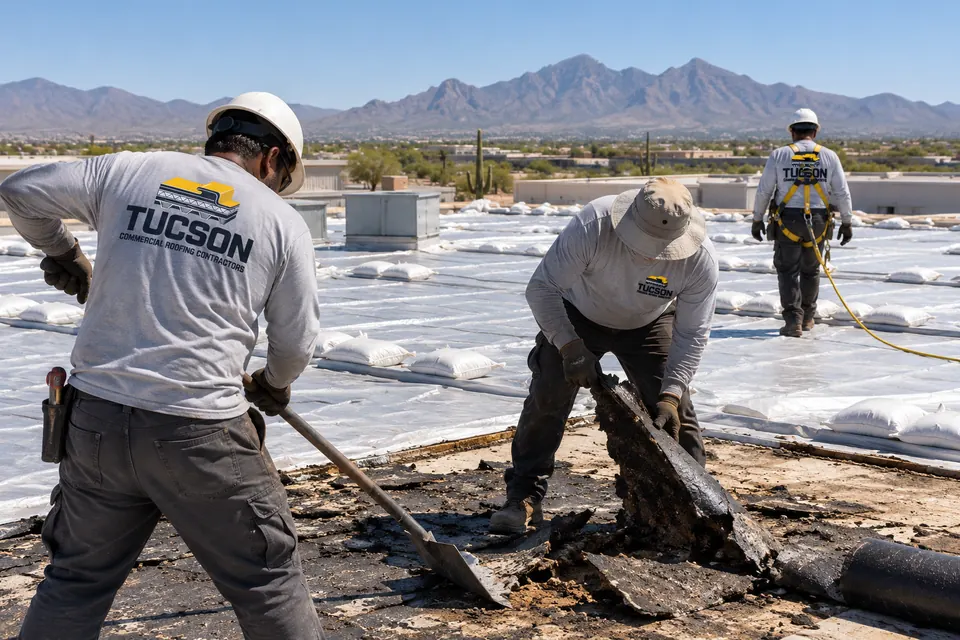
Tearing off a big roof all at once can force production or shipping to stop below the open deck.
Phased replacement keeps most of the building covered, with each section watertight before the shift ends.
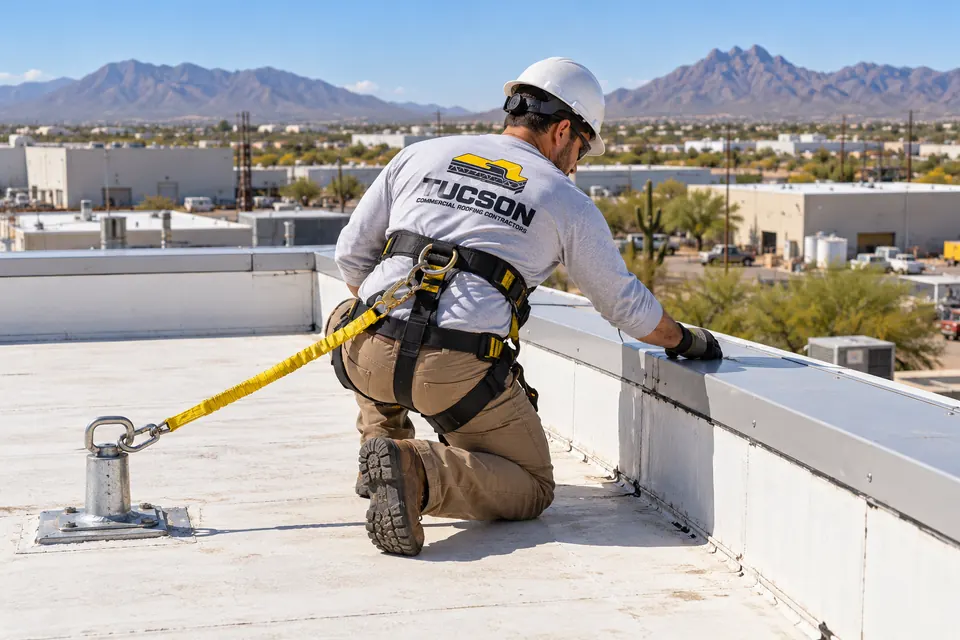
Roofs without anchors or guarded edges leave maintenance staff exposed at hatches and perimeters.
Roof work includes fall protection planning, and anchors or guarded paths can be added where the plant asks for them.
Call, describe what sits under the leak, and tell us the shift schedule. We plan the roof inspection around the plant.
The sequence keeps a plant running while its roof is replaced, one section at a time.
The roof survey maps equipment, exhaust points, supports, drains, and edges, with moisture readings taken across each section of the roof.
Tie-off points at roof edges, hot-work rules for welding near equipment, and restricted areas are agreed with the plant before anyone goes up.
The roof gets divided into sections sized to finish and close in one day, ordered around production lines and loading docks.
Curbs too low for new insulation get raised with the mechanical trade, and equipment supports get new pads under them.
Insulation, cover board, and membrane or panels go down section by section, with walk pads laid on each equipment path.
A marked roof plan shows equipment, walk paths, drains, and anchors, so maintenance staff know where to walk and what to check.
Most industrial roofs use one of these two systems, sometimes both on one building.
Process buildings and long-hold owners often choose standing seam metal for its long service life and fewer leak points.
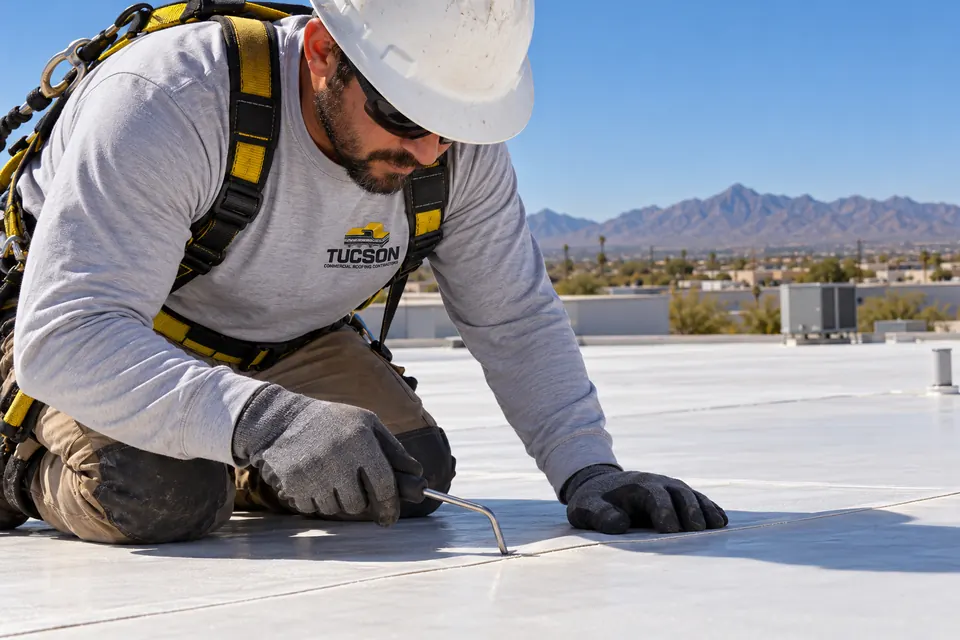
Large flat plant and distribution roofs often get welded TPO, with reinforced areas around equipment and exhaust.
Industrial roofs add phasing, heavy equipment, exhaust exposure, safety planning, and operations to an ordinary roof job. Large areas get replaced in sections that close each day, and the membrane near stacks gets matched to what they vent.
In most cases, yes. Roof sections are sized to open and close in a single day, noisy or dusty steps are timed with the plant, and areas below active work are marked off for safety.
We ask what each stack and fan vents, then check membrane compatibility with the manufacturer. Areas that get heavy exposure can receive a different sheet or extra protection.
Roofers tie off to anchors or use guarded work zones near edges, hatches, and skylights. Plant safety rules for permits, hot work, and restricted areas get followed alongside our own roof safety plan.
Usually they stay. Curbs get raised when the new insulation is thicker than the old, and that work is coordinated with the mechanical contractor so units are disconnected only briefly.
Twice a year at minimum, in late spring and fall, plus after major storms. Roofs with heavy equipment traffic benefit from a check after big maintenance projects too.
Walk pads on every equipment route, prompt repair of punctures, clean drains, and keeping technicians from storing parts on the membrane add years to a plant roof.
Tell us about the building, the equipment on top, and the shift schedule, and we will plan the roof inspection around them.
Leave a name and number, and we will call you back about the roof.