
Tucson Commercial Roofing Contractor
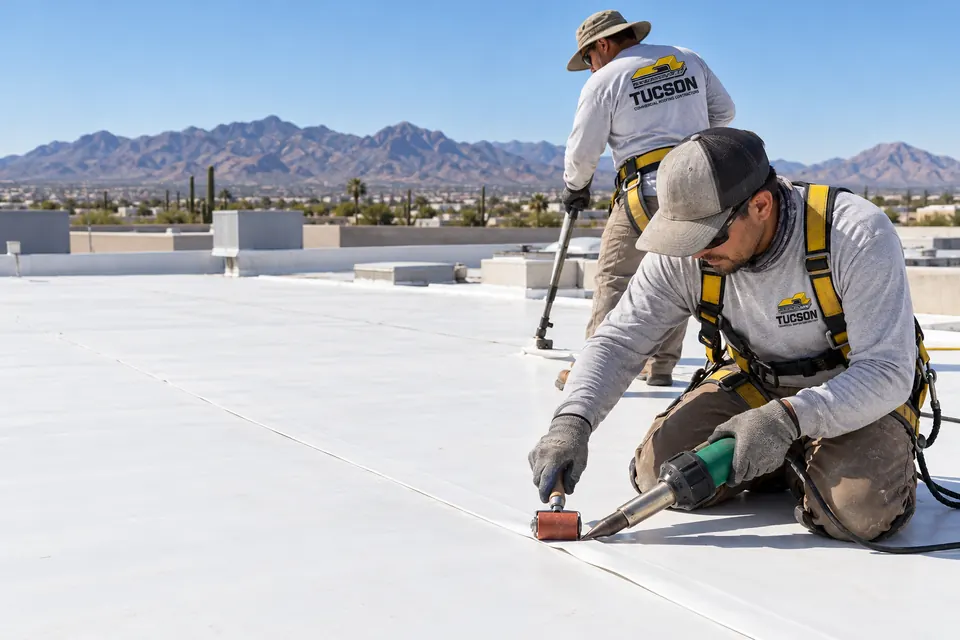
Tucson Commercial Roofing Contractor installs, replaces, and repairs TPO, EPDM, industrial, and metal roofs on commercial buildings across Tucson and 12 nearby communities.
Work Facts
- Inspection before any price
- Moisture checks on low-slope roofs
- Permits pulled for replacements
- Work timed around monsoon
Repair It Or Replace It
Most Tucson roofs we see need one of two things. These signs point to which one.
Signs A Repair Fits
- Leaks trace to one curb, drain, or seam
- Membrane still bends without cracking
- Insulation under the leak reads dry
- Metal panels are solid, with loose screws only
- Roof is in the first half of its expected life
Signs Replacement Fits
- Wet insulation shows up across large areas
- Membrane is brittle, crazed, or shrinking at the edges
- Leaks return in new spots after each repair
- Rust has eaten through panel laps and cut edges
- Solar or heavy equipment is about to go on top
How A Tucson Roof Job Runs
Every job follows the same six steps, from the first roof walk to the final check of each seam and flashing.
- INSPECT
Step 1: Inspect Your Roof
A roofer walks the whole surface, marks open seams, loose fasteners, soft spots, and damaged flashing, and photographs drains, scuppers, and rooftop units.
- CORE
Step 2: Test For Trapped Water
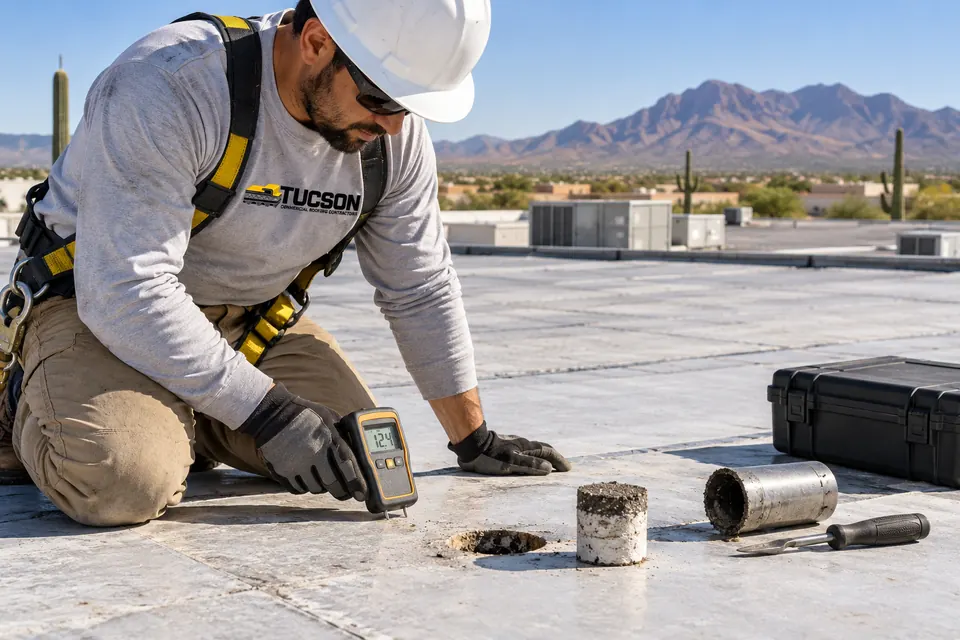
Low-slope roofs get moisture meter readings and a core cut. Dry insulation can stay under a recover; soaked boards come out.
- SCOPE
Step 3: Pick The System And Scope
Building use, rooftop traffic, and the existing deck decide between a repair, a TPO or EPDM roof, or metal. You get the reasons in writing.
- PERMIT
Step 4: Pull The Permit
Replacement roofs are permitted through the City of Tucson, the town, or Pima County, matched to the parcel, with inspections scheduled along the way.
- INSTALL
Step 5: Install In Sections
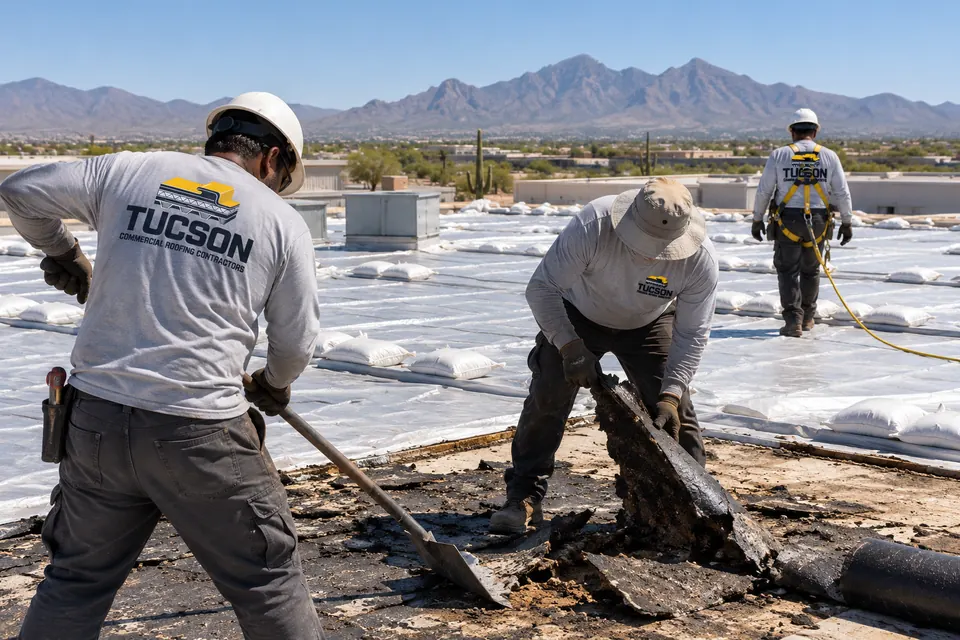
Old roofing comes off only as fast as new roofing goes on, so each section is closed and watertight before afternoon storms roll in.
- WALK
Step 6: Walk The Finished Details
Seams are probed, flashings and curbs checked, drains cleared of scrap, and photos of the details handed to you at the end.
Commercial Roofing Systems We Install
Four systems cover almost every commercial roof in the Tucson area. The table compares where each one fits.
| System | Roof slope | Seams | Surface and heat | Fits buildings like |
|---|---|---|---|---|
| TPO Roofing | Low slope, over tapered insulation where water sits | Heat-welded into one sheet | White, reflects summer sun | Retail, offices, medical, warehouses |
| EPDM Roofing | Low slope with many penetrations or odd shapes | Taped laps | Black, or white EPDM over cooled space | Older EPDM roofs, storage, irregular plans |
| Industrial Roofing | Large low-slope or metal roofs | Welded, taped, or panel seams | Matched to exhaust and chemical exposure | Plants, distribution centers, mining support |
| Commercial Metal Roofing | Sloped, or a retrofit frame that adds slope | Standing seam or exposed fasteners | Reflective factory finishes | Warehouses, shops, hangars, long-term owners |
Planning Roof Work Before Monsoon?
Late spring is the time to replace or repair a roof before storms start on June 15. Call with the details below, and we can set up an inspection.
What To Have Ready
- Approximate roof size
- Roof age and last repair
- Where water shows up inside
- Rooftop units, fans, or solar
What A New Commercial Roof Fixes In Tucson
Each row pairs a failure common on Tucson roofs with what the new roof does about it.
Sun-Dried Membrane
Months of summer UV dry out older membranes and asphalt surfaces until they craze, crack, and split at the laps.
A white TPO surface reflects much of that sun, and its heat-welded seams keep holding as the sheet moves between hot afternoons and cool nights.
Water That Sits
Flat roofs with low spots, small drains, or blocked scuppers hold water against seams and the base of rooftop units.
Tapered insulation, crickets, and overflow scuppers move water off the roof before it can find a weak seam.
Edges Lifted By Microbursts
Monsoon gusts get under loose edge metal and flashing at the perimeter, the first place a roof starts to peel.
New edge metal is fastened on a closer pattern, and the membrane is secured at the perimeter where wind pulls hardest.
Bruised Or Punctured Surfaces
Hail leaves bruises and small punctures on some membranes that start leaking weeks after the storm.
Thicker membranes, cover board under the membrane, or metal panels stand up to hail better, with dents on metal mostly cosmetic.
Signs Your Tucson Commercial Roof Needs Work
Sort what you see by how soon it needs attention. Anything marked Call Now means water is already getting in.
- Watch note it and check after storms
- Repair First fix before it spreads
- Call Now water is getting in
- Call Now
Ceiling Stains After Storms
Fresh stains or drips after a monsoon downpour mean an open seam, flashing, or drain is letting water through right now.
- Repair First
Open Or Wrinkled Seams
Lap edges that curl, wrinkle, or separate let wind-driven rain under the membrane. Small openings grow with every heat cycle.
- Repair First
Clogged Drains And Scuppers
Leaves, dust, and debris packed into drains and scuppers turn a short storm into standing water across the field of the roof.
- Watch
Cracked Curb Flashing
Rooftop units vibrate and expand in the heat. Cracks at the corners of curb flashing are an early sign before a leak shows inside.
- Watch
Loose Edge Metal
Edge metal that rattles or lifts at a corner after a windy storm is the starting point for a perimeter blow-off.
- Repair First
Soft Spots Underfoot
A membrane that gives when you step on it usually sits on wet insulation, which weakens the roof and feeds new leaks.
Commercial Roofing Across The Tucson Area
We work in Tucson and the 12 communities below, grouped the way the roads connect them.
North And Northwest
- Marana: hangars, metal shops, and warehouses near I-10
- Oro Valley: medical and lab roofs with air intakes
- Catalina Foothills: office roofs replaced ahead of solar
- Casas Adobes: retail centers worked tenant by tenant
- Catalina: inspections timed before and after monsoon
Central
- Flowing Wells: older flat roofs that pond after storms
- South Tucson: storefront roofs behind parapets
West And Southwest
- Drexel Heights: church and community roofs scheduled around use
- Valencia West: hail and storm damage inspections
Southeast And South
- Vail: school roofs planned around the calendar
- Sahuarita: agricultural and mining-support metal buildings
- Green Valley: campuses with several roofs phased together
Tucson Commercial Roofing Contractor Questions
How long does a new commercial roof last in Tucson?
TPO and EPDM roofs last roughly 20 to 30 years when they are installed well and maintained, and a cared-for metal roof can pass 40 years.
Sun exposure, drainage, and how fast small problems get fixed after each monsoon decide where in that range a Tucson roof lands.
Is a recover cheaper than a full tear-off?
A recover over the old roof skips disposal and labor, so it usually costs less. It only works when the insulation underneath is dry and the deck is solid, and code limits how many roofs can be stacked. A core cut answers both questions.
What drives the price of a commercial roof?
Roof size, how much wet insulation must come out, the number of curbs and penetrations, edge metal, access for lifts, and the system chosen move the price most. Working around open businesses or production shifts also changes the schedule and cost.
Should my building get TPO, EPDM, or metal?
Building use points the way. White TPO fits retail and offices with rooftop HVAC, EPDM handles roofs crowded with penetrations, and metal suits warehouses and owners planning to hold the building for decades. The existing deck and budget settle the final choice.
Can a new roof go over my existing one?
Often, yes. TPO or EPDM can recover a dry low-slope roof, and a metal retrofit frame can sit over an old flat roof to add slope. Wet insulation, a damaged deck, or two existing layers mean the old roof comes off first.
When should a Tucson roof be inspected?
Twice a year works best: late spring, before the monsoon starts on June 15, and fall, after it ends on September 30. Spring visits catch clogged drains and open seams, and fall visits catch storm and hail damage.
What should I do if the roof leaks during a storm?
Move equipment and stock away from the drip, catch the water, and note where it lands and when. Call us so the roof can be checked once the storm passes and a temporary patch stops the leak until repairs are made.
Get A Free Estimate For Your Tucson Roof
Tell us about the building and the roof, and we will set up an inspection to look at seams, drains, and moisture.