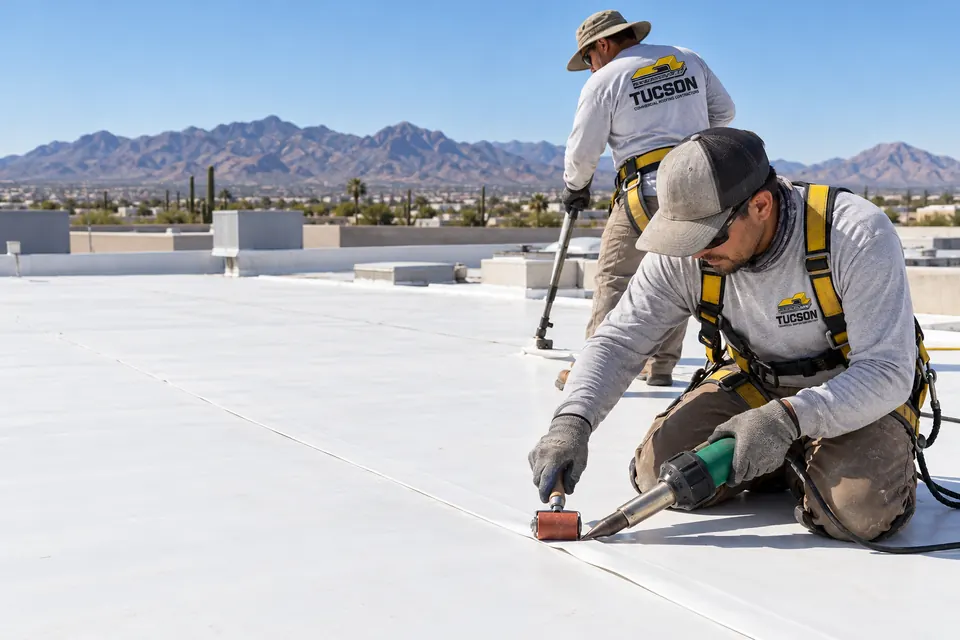
Roofer heat-welding a white TPO seam with a hand welder and roller on a Tucson commercial roof

Tucson Commercial Roofing Services

Our commercial roofing services in Tucson cover four systems: TPO, EPDM, industrial roof assemblies, and metal. Each one is installed new, replaced, or repaired.

Four Roof Systems For Tucson Buildings

Each card gives the short version: what the system is, where it fits best, and when another system makes more sense.

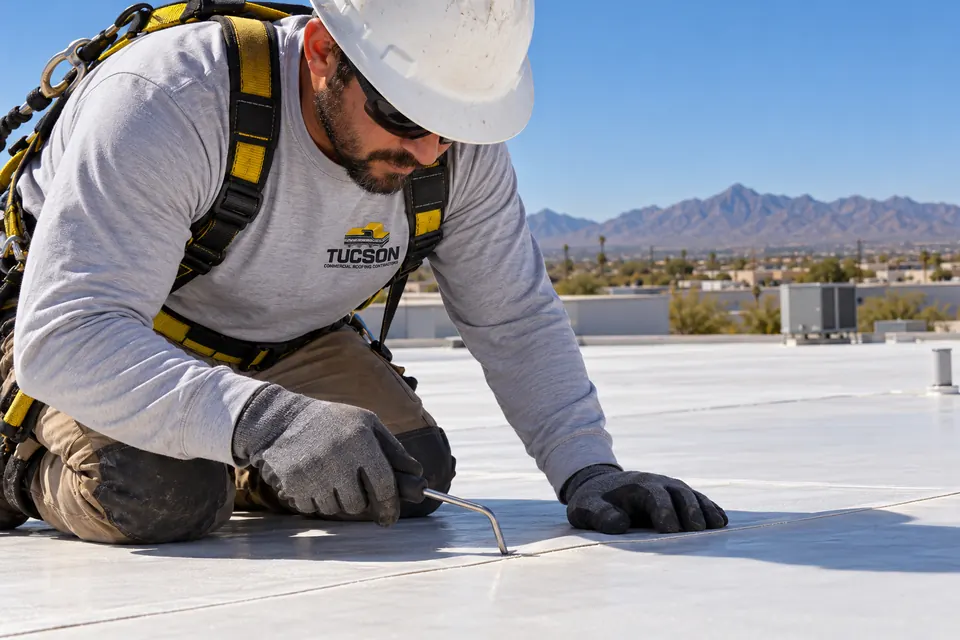
Roofer probing a heat-welded TPO seam on a commercial roof

TPO Roofing

A white single-ply membrane with seams heat-welded into one sheet. It reflects summer sun off retail, office, and medical roofs and resists wind-driven monsoon rain at the laps.

Best forLow-slope roofs over cooled space with rooftop HVAC
Look elsewhere ifThe roof slopes steeply or the deck is failing
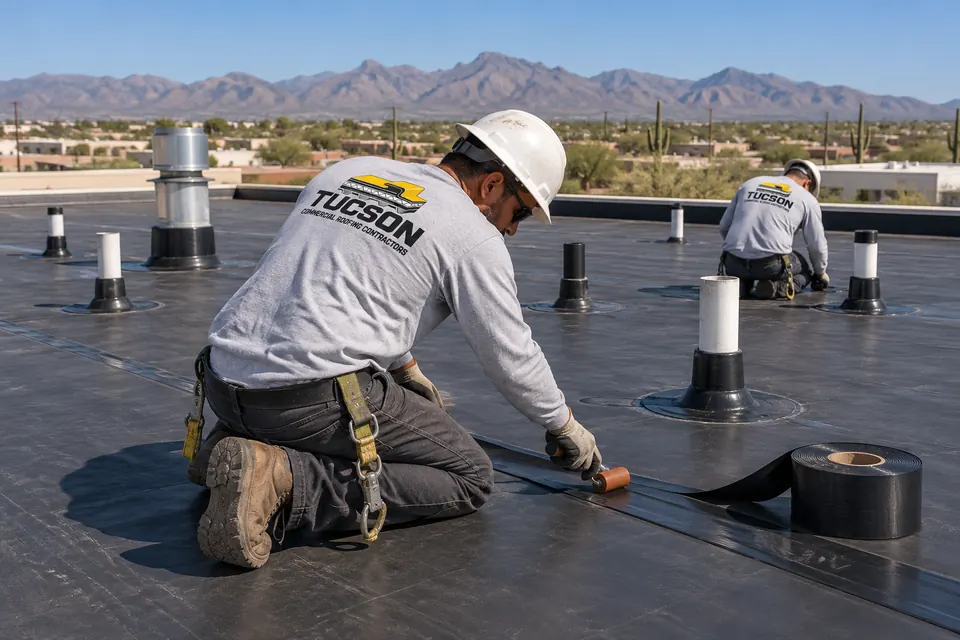
Roofer taping a seam on a black EPDM roof with pipe penetrations

EPDM Roofing

Synthetic rubber that stays flexible from hot afternoons to cold nights. Roofs crowded with pipes, curbs, and odd corners are easier to detail with a flexible sheet.

Best forPenetration-heavy roofs and existing EPDM in good shape
Look elsewhere ifBlack membrane would sit over air-conditioned offices
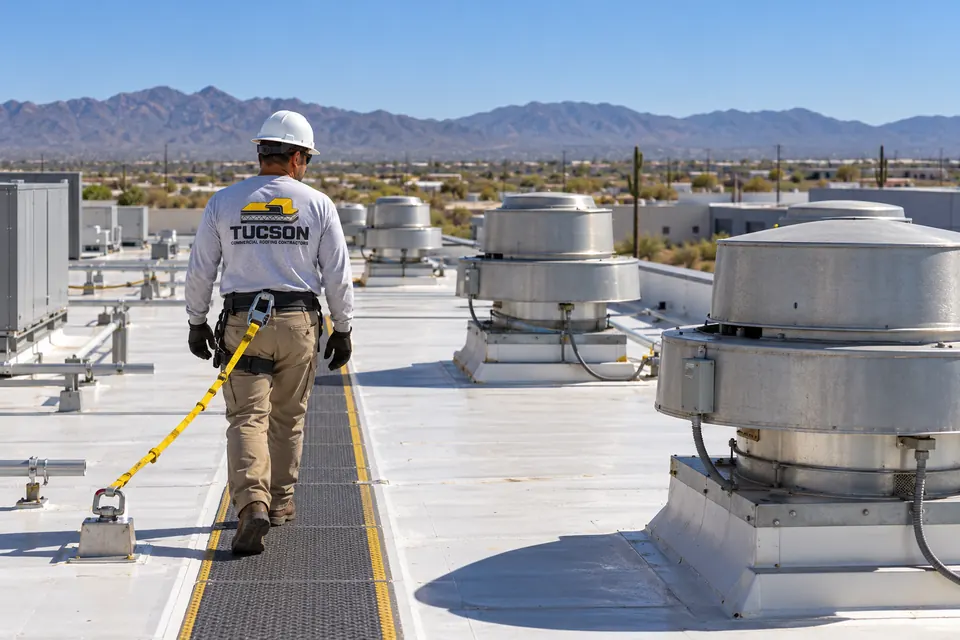
Roofer on a walk pad between exhaust fans on an industrial roof

Industrial Roofing

Large plant, distribution, and mining-support roofs replaced in phases, with reinforced membrane and walk paths around heavy equipment and the right sheet near exhaust stacks.

Best forBig roofs with fans, process equipment, and shift schedules
Look elsewhere ifThe building has one small roof and no equipment
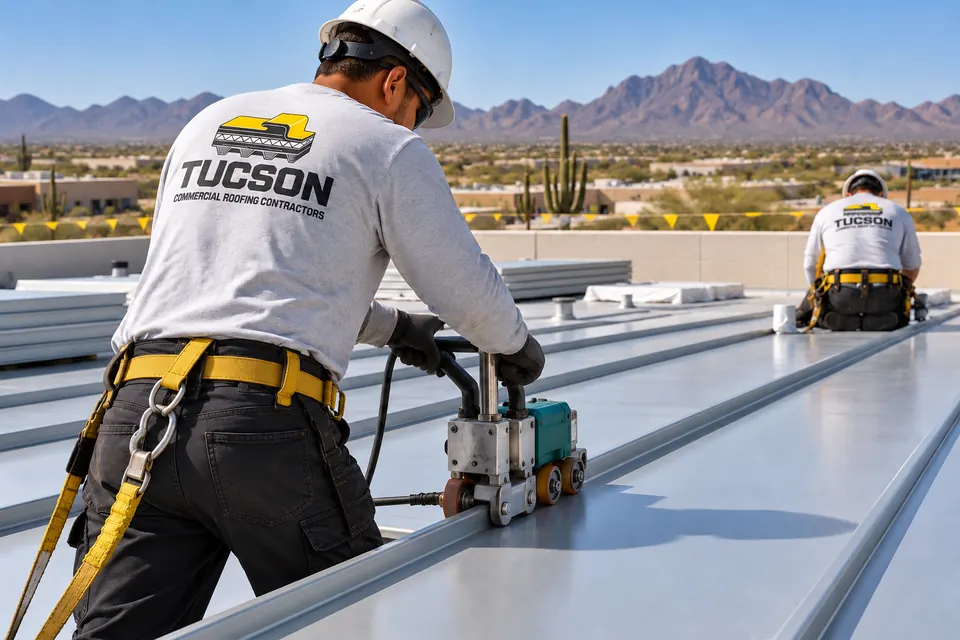
Roofer seaming a standing seam metal roof panel

Commercial Metal Roofing

Standing seam panels with hidden clips, exposed-fastener panels for shops and warehouses, and retrofit framing that turns a ponding flat roof into a sloped one.

Best forWarehouses, shops, hangars, and long-term owners
Look elsewhere ifRooftop units crowd a flat roof with no room to slope

Matching A Roof System To Your Building

Building use usually points to the best fit. The rows below follow the building types we see most around Tucson.

The existing deck, budget, and length of ownership settle the final choice.
BuildingSystems often usedWhat drives the choice
Retail centers and officesWhite TPORooftop HVAC, foot traffic to units, cooling bills, welded seams at curbs
Medical and occupied buildingsTPO or EPDM, low-odor installFresh-air intakes on the roof, people inside during the work
Warehouses and distributionTPO, or metal for long lifeRoof size, loading docks below, how long you will own it
Manufacturing and industrialTPO, EPDM, or metalRooftop equipment, exhaust, chemical exposure near stacks
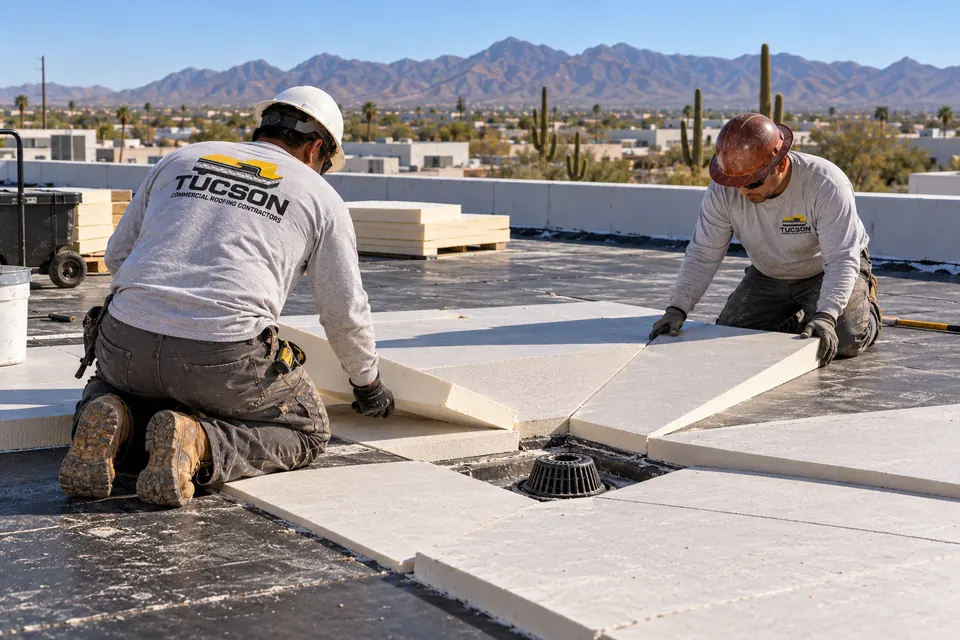
Older flat roofs that pondMetal retrofit, or new membrane over tapered insulationWhere water sits, drain size, the condition of the deck

Not Sure What Is On Your Roof?

Many owners inherit a roof with no records. Call and describe the surface color and texture, and we can tell you what to look for.

What To Have Ready

  • Surface color: white, black, or metal
  • Building use and age
  • Any rooftop units or fans
  • Leak spots inside

From First Visit To Final Walk

The same six steps apply whichever of the four systems your building ends up with.

  1. INSPECT

    Step 1: Inspect Your Roof

    Each visit starts on the roof surface: seams, laps, fasteners, curbs, drains, and edge metal are checked and photographed before any system is discussed.

  2. CORE

    Step 2: Read The Insulation

    Moisture meter readings and a core cut tell whether the insulation is dry. That one answer splits recover jobs from full tear-offs.

  3. MATCH

    Step 3: Match The System To The Building

    Rooftop traffic, exhaust, cooling load, and how long you will own the building narrow the choice to one or two systems.

  4. PREP

    Step 4: Set Up Access And Staging

    Roof access points, lift locations, material drops, and walk paths get planned around entrances, docks, and parking so tenants and trucks keep moving.

  5. INSTALL

    Step 5: Build The New Roof

    Insulation, cover board, membrane or panels, flashings, and edge metal go on section by section, and every section closes before day end.

  6. CLOSE

    Step 6: Check And Clean Up

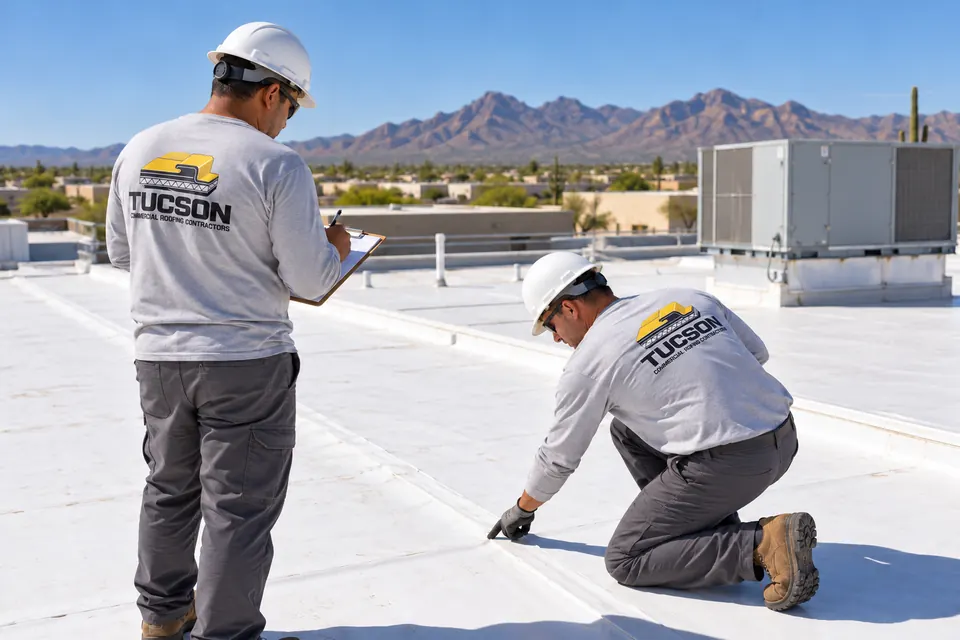
    Welds are probed, fasteners and laps checked, drains and gutters cleared of scrap, and photos of finished details handed over.

Roofers fitting tapered insulation boards around a roof drain
Two roofers checking a white membrane roof with a clipboard during a final walk

Commercial Roofing Services Questions

Which roof system fits my type of building?

Start with how the building is used. Retail and offices with rooftop HVAC usually get white TPO, medical buildings get TPO or EPDM installed with low-odor methods, and warehouses get TPO or metal.

Plants pick TPO, EPDM, or metal based on equipment and exhaust, and older flat roofs that pond can take a sloped metal retrofit.

What is the difference between TPO and EPDM?

TPO is a white thermoplastic sheet with seams fused by hot air. EPDM is a rubber sheet, usually black, joined with seam tape. TPO reflects more heat; EPDM bends more easily around crowded penetrations.

When does metal beat a membrane roof?

Metal makes sense on sloped roofs, warehouses and shops, and buildings an owner will hold for decades. A metal retrofit can also add slope over a flat roof that ponds, so monsoon rain runs off.

Do you repair roofs you did not install?

Yes. Most repair calls are on roofs installed by someone else. The inspection identifies the membrane or panel type, and repairs use matching materials so new patches bond to the old surface.

Can one leak be fixed without replacing the roof?

Usually. A single open seam, cracked curb flashing, or failed pipe boot gets repaired on its own. When moisture readings show wet insulation spreading far past the leak, replacement starts to make more sense.

Where do most commercial roof leaks start?

Leaks rarely start in the open field of the roof. Most begin at curbs around rooftop units, pipe boots, wall and parapet flashing, drains, and lap edges, the details that move with every hot afternoon and cool night. Those spots get checked first on every inspection.

How fast should storm damage be repaired?

Active leaks get a temporary patch as soon as the roof is safe to walk, then a permanent repair. Waiting lets water soak insulation and spread under the membrane, which turns a repair into a replacement.

Do commercial roof replacements need permits?

Commercial roof replacements in the Tucson area generally require a permit and inspections. The permit comes from the City of Tucson, South Tucson, Marana, Oro Valley, Sahuarita, or Pima County, based on where the building sits.

Do you install roofs on new commercial buildings?

Yes. New buildings get the same systems as replacements: TPO, EPDM, or metal over the deck the designer specified. We follow the roof plan for insulation, drains, and edge details, and coordinate curb and penetration locations with the mechanical contractor before the membrane goes down.

What sets the length of a roof replacement?

Roof size, how much wet insulation comes out, the number of curbs and penetrations, and how many sections can be opened each day set the schedule. Monsoon afternoons shorten working days in summer, so larger replacements are often planned for spring or fall.

Can the building stay open during roof work?

In most cases. Work runs one section at a time, entrances and docks stay usable, and noisy or odor-producing steps are scheduled around business hours when the building use calls for it.

Get An Estimate For Your Commercial Roof

Tell us the building type and what you see on the roof, and we will inspect it and recommend one of the four systems.

Call Us (623) 310-0220