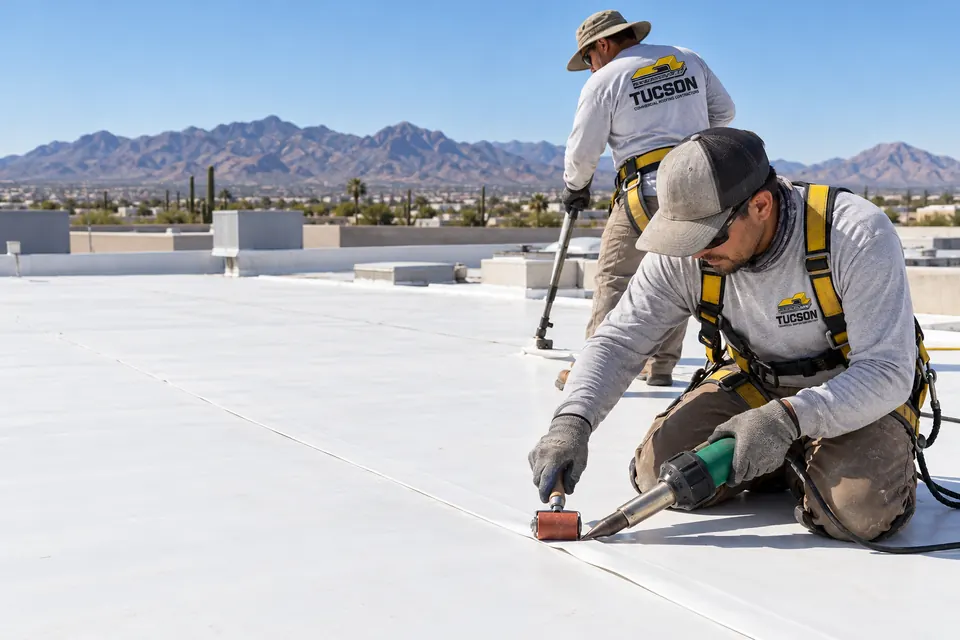
TPO Roofing
Welded white TPO suits owners who want the most reflective surface over offices and stores with rooftop HVAC.
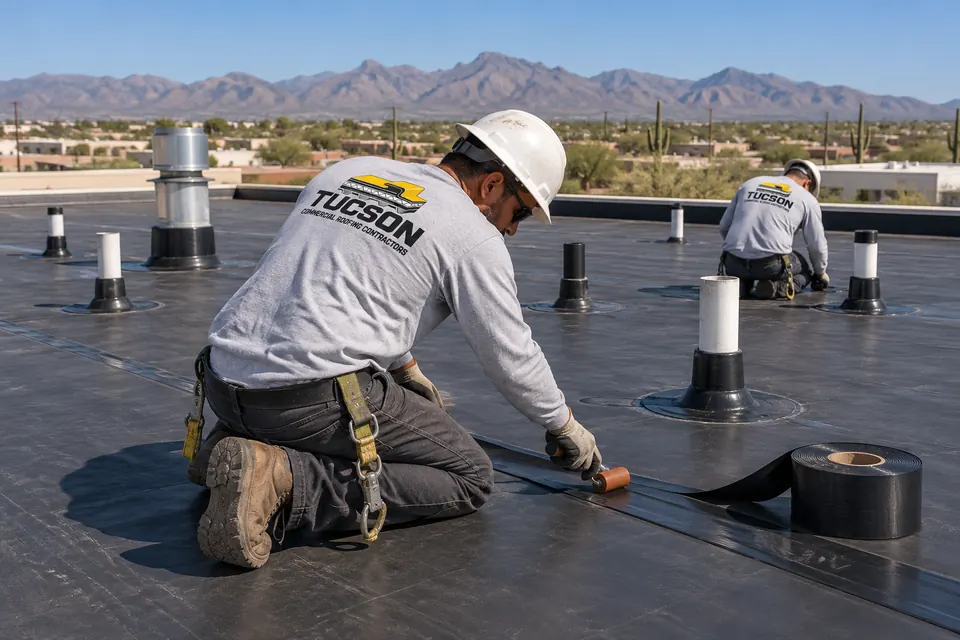
We work as an EPDM roofing contractor in Tucson, installing, replacing, and repairing rubber roofs on buildings crowded with pipes, curbs, skylights, and odd corners.
EPDM earns its place on irregular roofs and buildings that already have it. The right column shows where we steer owners elsewhere.
EPDM fails in a few predictable places. Here they are, sorted by how soon each needs work.
Lap edges curl back where primer or tape has aged. A fingertip slid under the edge finds the open lap before the ceiling does.
Older sheets shrink and pull away from walls, bridging the corner where the roof meets the parapet and leaving the flashing in tension.
Rubber boots crack at the top after years of sun. Rain then runs down the vent pipe and drips into the room below.
Dirt circles on black EPDM show where water stands. Seams sitting inside those rings fail first.
Hail can bruise or puncture a thin sheet. Small holes are hard to see on black rubber until a hose test or a leak finds them.
Skylight curbs flashed with uncured rubber or sealant open at the corners, and water tracks down the curb wall.
Most EPDM jobs fall into one of these four paths. Moisture readings and the age of the sheet decide which.
| Option | When it fits | What the work includes |
|---|---|---|
| Seam and flashing repair | Sheet still stretches and rebounds, leaks at laps or boots only | Cleaned and primed laps, new cover tape, new boots and curb flashing |
| Section replacement | One area is damaged or wet while the rest stays dry | Removal of the damaged area, new insulation, new EPDM spliced to the old sheet |
| White EPDM or reflective topcoat | Black sheet in good condition over air-conditioned rooms | White EPDM on new work, or a compatible reflective topcoat on the existing sheet |
| Full tear-off and new EPDM | Widespread wet insulation, shrinkage, or repeated seam failures | Removal to the deck, new insulation, new EPDM adhered or fastened |
Each row names a failure common on older Tucson roofs and what a new EPDM roof changes.
Rigid flashing and pitch pans around crowded pipes crack as the roof heats and cools each day.
Flexible EPDM flashing stretches around pipes and curbs, which cuts down the number of sealant joints to maintain.
Brittle built-up and modified roofs split when a hot afternoon gives way to a cool desert night.
EPDM stays flexible across a wide temperature range, so it moves with the deck through Tucson summer and winter.
Years of mastic and mixed patch materials leave a roof where new repairs will not stick.
A new EPDM sheet gives one clean, matching surface, and future repairs bond with the same tape and primer.
Black rubber over air-conditioned rooms absorbs Tucson sun all afternoon.
White EPDM or a compatible reflective topcoat keeps a flexible roof while reflecting more of that heat.
Call and tell us how many laps look loose and where the water shows inside. A lap repair may be all the roof needs.
These six steps cover both new EPDM roofs and large repairs on existing rubber roofs.
Laps, boots, curbs, parapets, and drains get checked by hand, and soft spots, shrinkage, and punctures are marked on a roof sketch.
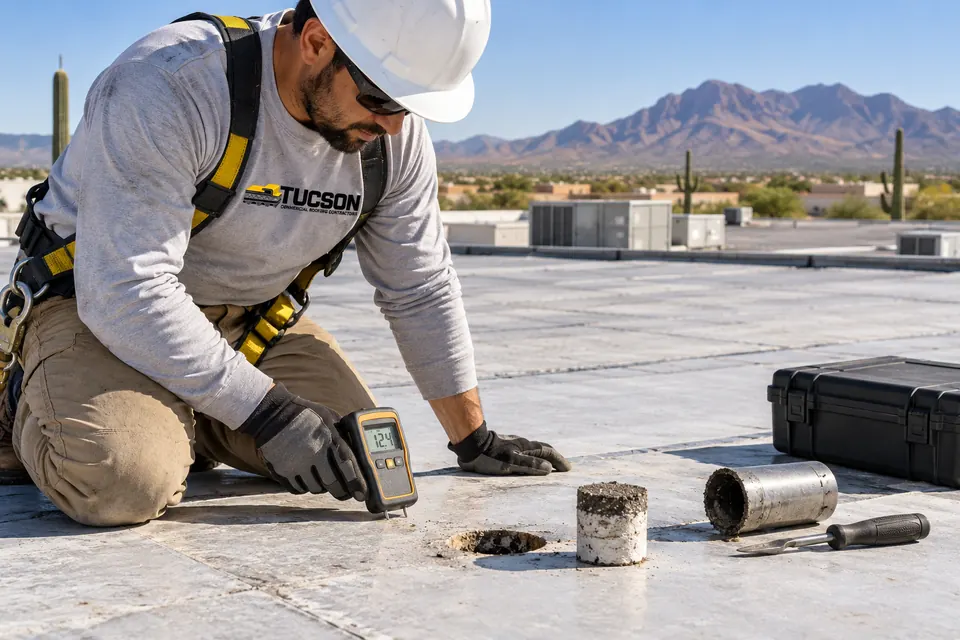
A stretch test and a core cut show whether the old EPDM still flexes and whether the insulation below it is dry.
Layout keeps laps away from drains and low spots, with as few seams as the roof shape allows.
Old roofing comes off section by section, the deck is repaired, and new insulation and cover board are fastened down.
Sheets are adhered or fastened, laps cleaned, primed, and taped, and every pipe boot, curb, and parapet flashed in rubber.
Lap edges get rolled and checked along their full length, drains cleared, and termination bars at walls tightened.
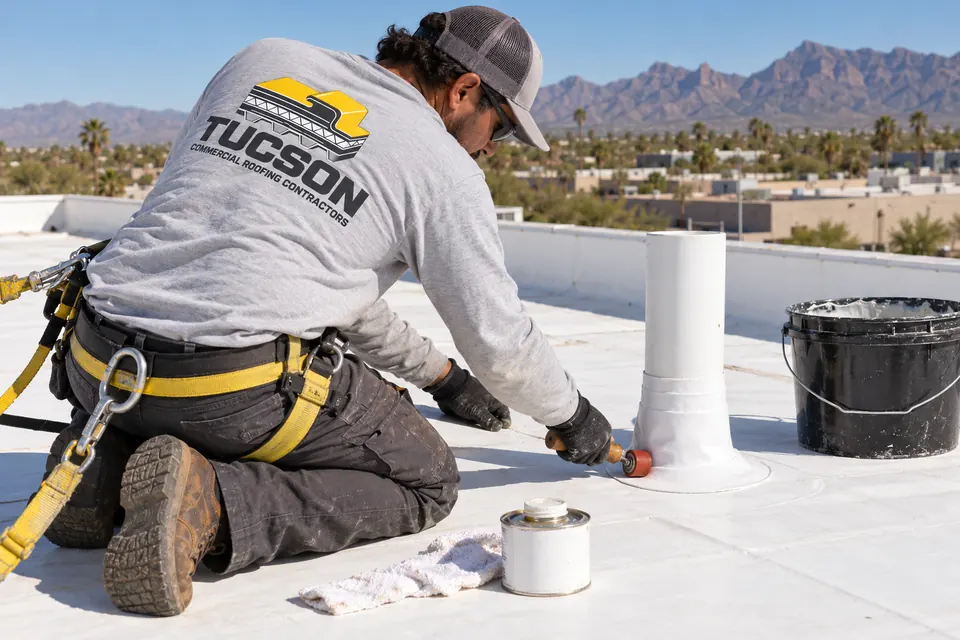
Two other systems often come up when an owner compares EPDM.
Welded white TPO suits owners who want the most reflective surface over offices and stores with rooftop HVAC.
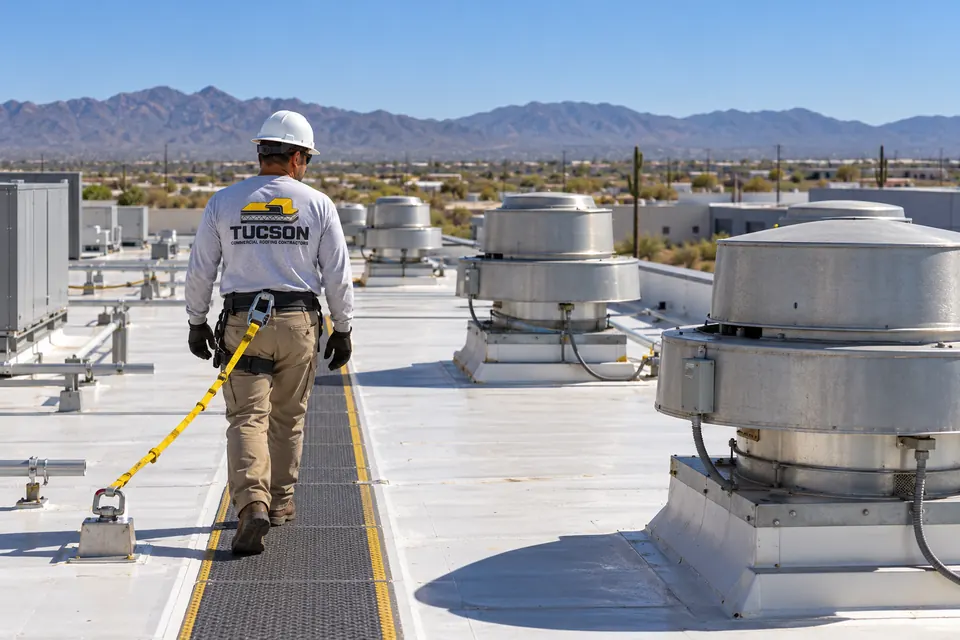
Plants with process exhaust need a membrane checked against what comes out of the stacks, which the industrial roofing page covers.
EPDM wins on roofs with many penetrations, curbs, or irregular shapes, where a flexible sheet makes flashing simpler, and on buildings that already have EPDM in good structural condition. Warehouses with little cooling load are another strong fit.
Black EPDM absorbs heat, which matters most over air-conditioned rooms. For those spaces, white EPDM or a compatible reflective topcoat is worth pricing. Over storage space the black sheet works fine.
Roughly 20 to 30 years with good installation and regular care. Ponding water, foot traffic, and how fast lifted laps get repaired after storms decide where a roof lands in that range.
Usually, if the sheet still stretches and springs back. The old surface is cleaned and primed, then patched with seam tape or cured rubber. A sheet that cracks when folded is near the end of its life.
Older laps were often glued with liquid adhesive that weakens with age and heat. Modern repairs remove the old adhesive at the edge, prime the rubber, and apply seam tape with a cover strip.
Both methods are used. Fully adhered sheets lie flat and resist wind well, while mechanically fastened sheets install faster on large roofs. Deck type and wind exposure at the roof edge decide which one fits.
Yes. A new section can be spliced to an existing sheet in good condition with primer and splice tape. That lets an owner replace the worst area now and the rest later.
Tell us about the laps, boots, and leaks you are seeing, and we will inspect the rubber roof.
Leave a name and number, and we will call you back about the roof.