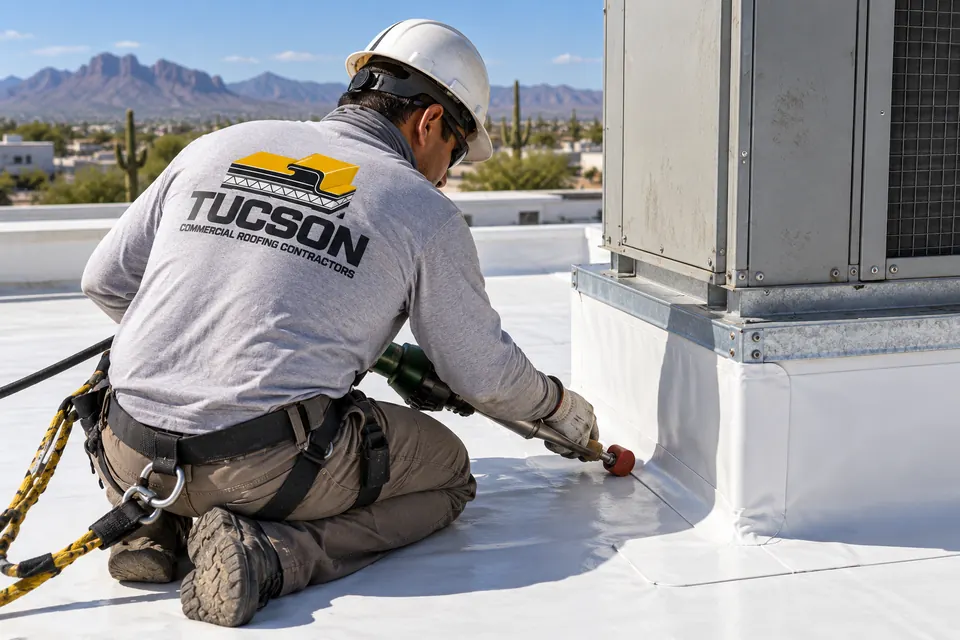
TPO Roofing
Flat office additions beside a metal warehouse often get white TPO, welded around their rooftop units.

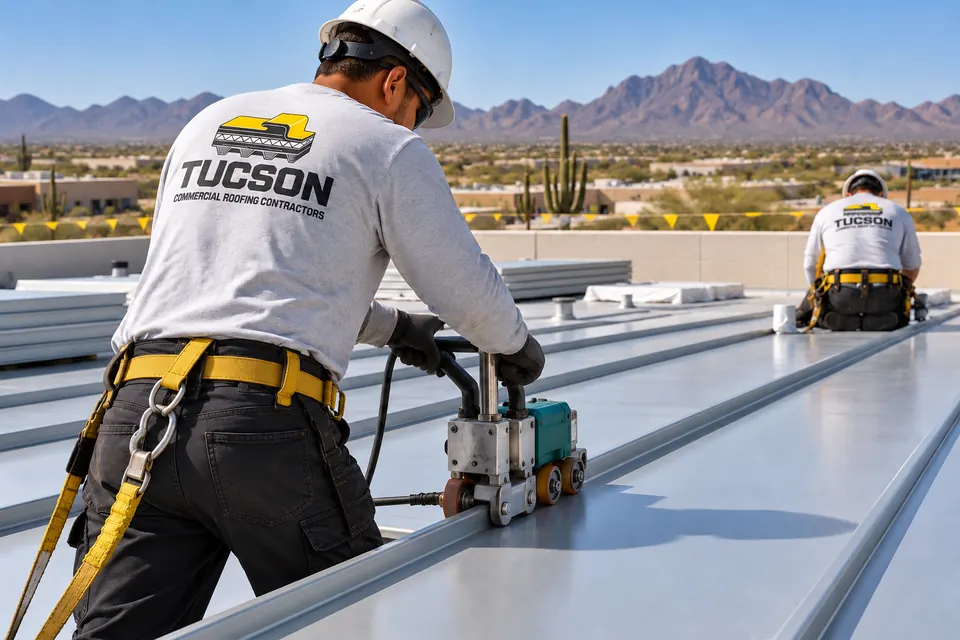
As a commercial metal roofing contractor in Tucson, we install standing seam and exposed-fastener metal roofs, build retrofit frames over flat roofs, and repair leaking panels.
Metal suits buildings an owner plans to keep and flat roofs that need slope. The right column shows when another system makes more sense.
Metal roofs fail at their joints and holes long before the panels wear out. These are the spots we check first.
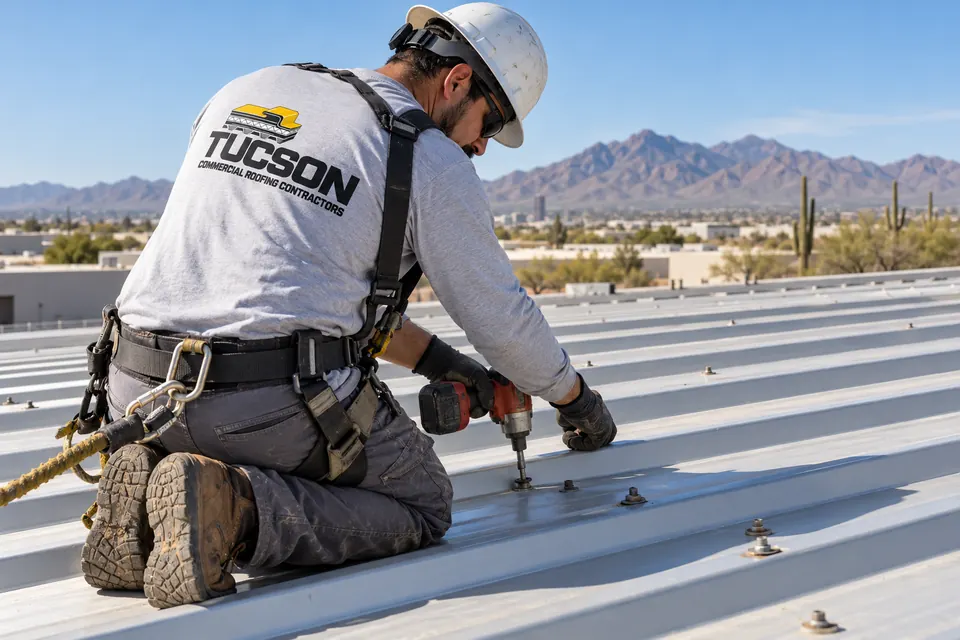
Rubber washers under exposed screws harden in Tucson sun, and each screw becomes a small leak path along the panel rib.
Where one panel overlaps the next, sealant tape dries out and water wicks up the lap during heavy rain.
Cut panel edges and scratched finish start to rust first, especially along gutters and at the eave.
Translucent panels and skylight curbs crack around their fasteners, and water drips onto the floor below during storms.
Ridge caps and rake trim loosen in monsoon gusts. Rattling trim is the warning before wind peels a panel edge.
Large hail can dent panels. Most dents are cosmetic, but dents at laps and fasteners get checked for opened seals.
Metal work in Tucson falls into four main paths, from a fastener program to a full retrofit frame.
| Option | When it fits | What the work includes |
|---|---|---|
| Fastener and lap repair | Solid panels with leaks at screws and laps | Oversized replacement fasteners, new lap sealant, new trim screws |
| Standing seam roof | New roof on a sloped structure, long ownership | Concealed clips, machine-locked seams, new trim and flashing |
| Exposed-fastener panels | Warehouses, shops, agricultural and utility buildings | New panels and fasteners, with fasteners checked on a schedule |
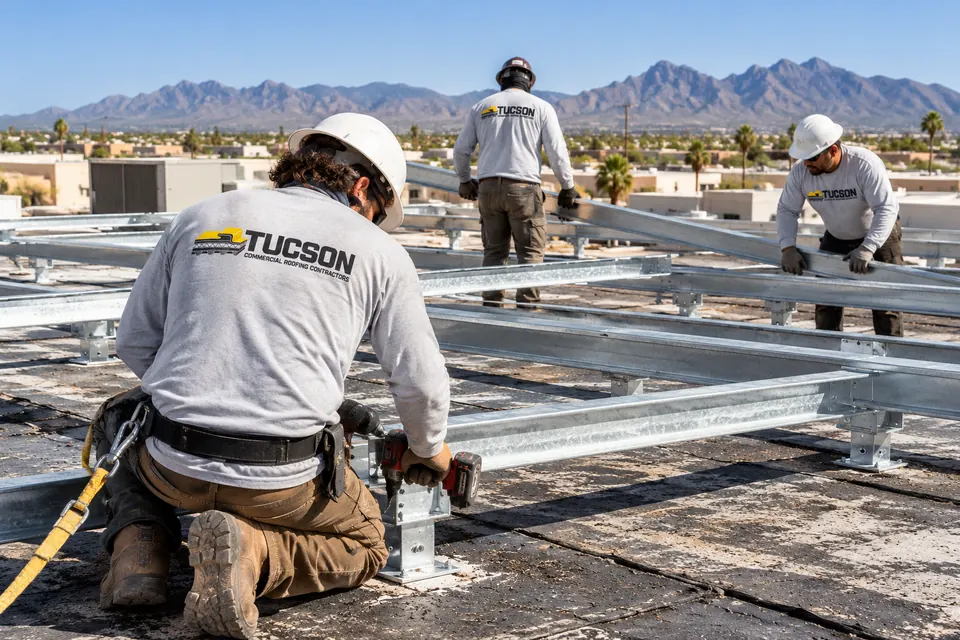
| Metal retrofit over a flat roof | Flat roof that ponds and has structure for a frame | Steel framing over the old roof, new slope, new panels shedding water |
Each row starts with a failure common on Tucson commercial roofs and shows what metal does about it.
Dead-flat roofs hold monsoon water against seams until it finds a way through the membrane.
A retrofit frame adds slope over the old roof, so rain runs off the panels and into gutters.
Older exposed-fastener roofs carry thousands of screws, each with a washer that dries out.
Standing seam panels hold on hidden clips under raised seams, which leaves far fewer holes through the roof.
Thin membranes can bruise or puncture under hail and leak weeks after the storm.
Metal resists hail better than many low-slope membranes, and large hail usually leaves cosmetic dents.
Membranes and built-up roofs need replacing every few decades on a building the owner plans to keep longer.
A well-maintained metal roof can last 40 years or more, which suits long-term owners.
Call and tell us whether the leak follows a panel rib or shows up at a lap, and roughly how old the panels are.
These steps cover new metal roofs and retrofit frames over existing flat roofs.
Panels, laps, fasteners, trim, gutters, and skylights get checked on existing metal. Flat roofs get moisture readings and a look at the structure for a retrofit.
Roof dimensions, slope, and any retrofit frame layout are drawn up so panels arrive cut to length for each run.
Replacement and retrofit roofs are permitted through the city, town, or Pima County, and a retrofit frame gets reviewed for added load.
Retrofit jobs get steel framing fastened through the old roof to the structure. Panel replacements get new underlayment where needed.
Clips and panels go on run by run, seams are locked with a seamer, and trim, ridge, and flashing close each section.
Seams, trim fasteners, gutters, and flashings get a final look, and metal shavings are swept off so they cannot rust on the finish.
Metal often shares a building with one of these systems.
Flat office additions beside a metal warehouse often get white TPO, welded around their rooftop units.
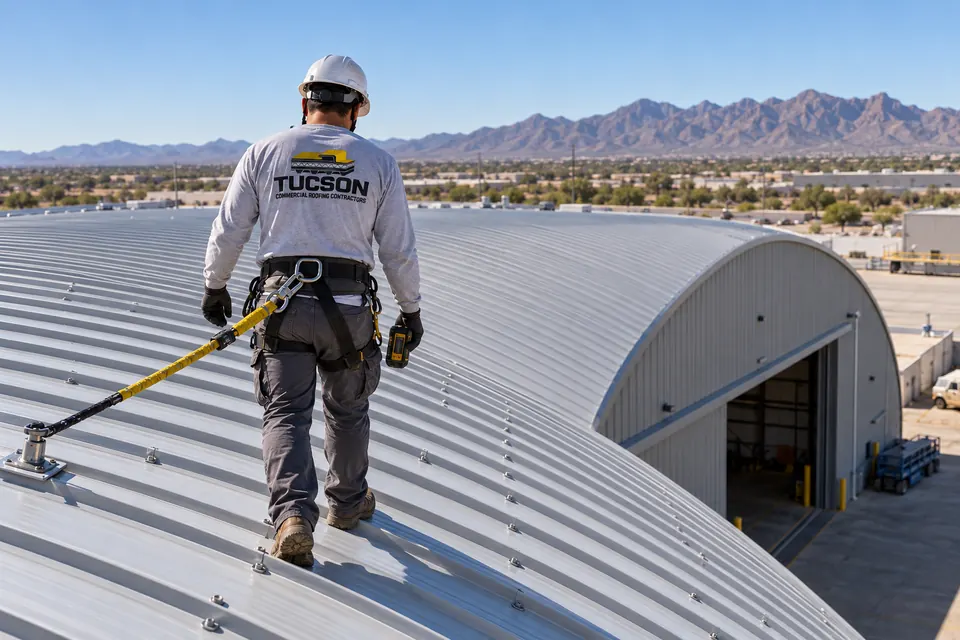
Large process buildings and hangars with metal roofs need phasing and safety planning covered on the industrial roofing page.
Three main options: standing seam panels with concealed fasteners, exposed-fastener panels for warehouses and shops, and retrofit systems that frame over an existing flat roof to add slope. Each one uses reflective factory finishes on request.
Metal resists hail better than many low-slope membranes. Large hail can leave cosmetic dents, and dents at laps or fasteners get checked to make sure the seals stayed tight.
A well-maintained metal roof can last 40 years or more. Fastener checks, sealant renewal, and clean gutters after each monsoon are what keep a roof at the long end of that range.
Steel framing gets fastened through an existing flat roof to the structure below, creating slope, and metal panels go on top. Rain then drains off the edge rather than standing on the old roof.
A retrofit adds weight and changes how wind loads reach the structure, so the existing framing gets checked before design. Permit offices review the added load as part of the roof permit.
Yes, when the panels are solid. Old fasteners come out and oversized ones with new washers go in, and laps get new sealant. Rust through the panel means the panel gets replaced.
Plan on a check every year or two, and after storms with strong wind or hail. Washers dry out in the sun, so catching loose screws early keeps the deck and insulation dry.
Tell us about the building and the panels, or the flat roof you want to slope, and we will inspect it.
Leave a name and number, and we will call you back about the roof.