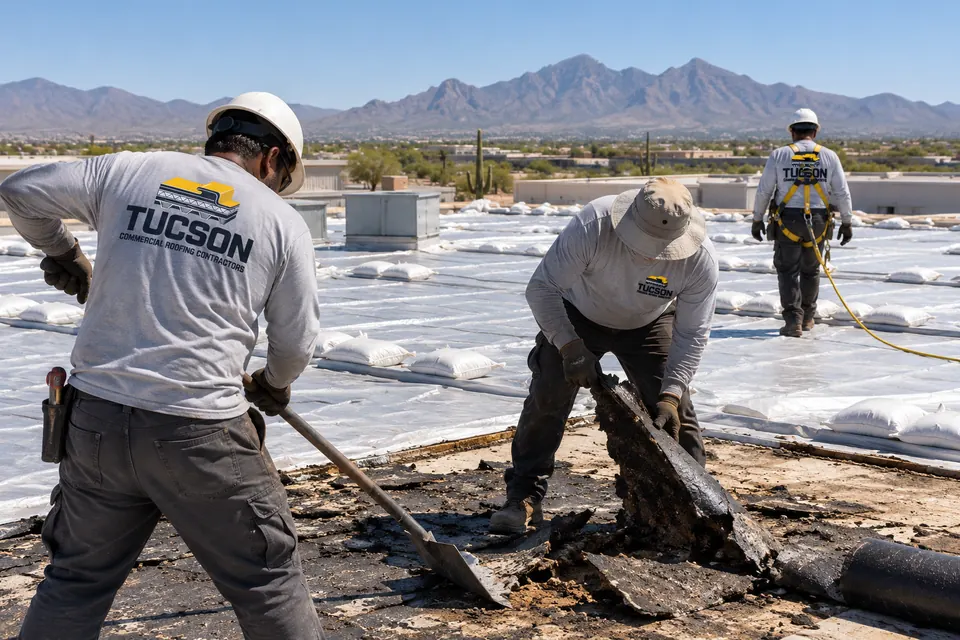
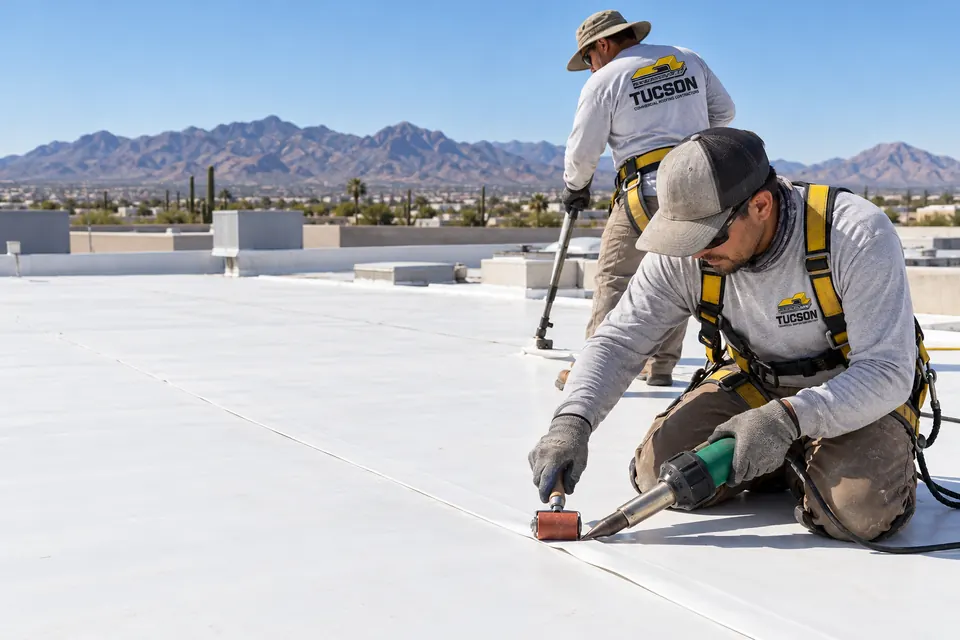
Roofer heat-welding a white TPO seam with a hand welder and roller on a Tucson commercial roof

Flowing Wells Commercial Roofing Contractor

As a Flowing Wells commercial roofing contractor, we repair and replace older low-slope roofs that hold water, adding slope, crickets, and overflow scuppers so monsoon rain leaves the roof.

Older Flat Roofs With Poor Drainage

Many commercial buildings on the northwest edge of Tucson were built with nearly flat roof decks, and decades of settling have left low spots between the drains.

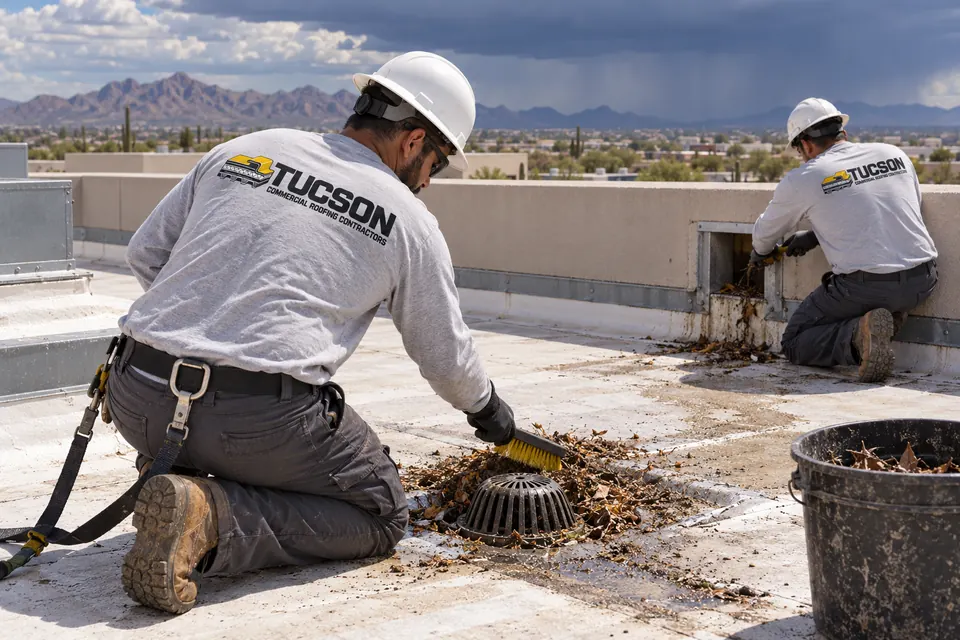
Roofer clearing a roof drain and overflow scupper under storm clouds

Monsoon storms drop a lot of water in a short burst. On a roof with little slope, that water collects in shallow ponds that sit for days, softening laps and pushing into any seam that has opened.

We measure where water stands and how deep it sits, then add slope with tapered insulation and crickets, open new overflow scuppers, or frame a metal retrofit with built-in pitch over the old deck.

  • Ponds measured after storms
  • Drains and scuppers sized for bursts
  • Tapered insulation toward each outlet

Roof Problems On Flowing Wells Flat Roofs

Look for these on the roof after a storm, and sort them by how soon they need work.

  • Watch note it and check after storms
  • Repair First fix before it spreads
  • Call Now water is getting in
  • Repair First

    Water Standing After 48 Hours

    Ponds still on the roof two days after a storm mean the deck has sagged or the slope never reached the drains. Membrane under those ponds wears out first.

  • Call Now

    Water Backing Over Parapets

    Rain spilling over a parapet or through the wall during a downpour shows that drains and scuppers are blocked or undersized, and roof loads are rising.

  • Repair First

    Lap Seams Under Ponds

    Laps that sit under water most of the season lose adhesion, and leaks appear inside below the low spots instead of near the drains.

  • Watch

    Soft Spots Underfoot

    Insulation soaked by slow leaks crushes when walked on. Soft areas around ponds signal wet insulation that holds water against the deck.

  • Watch

    Dirt Rings And Algae Lines

    Rings of dried dirt on the membrane trace the edge of each pond. Wide rings far from any drain mark the spots needing added slope.

  • Repair First

    Rusted Deck Below Ponds

    Steel decks under long-standing ponds rust from the top down. Rust stains on the underside of the deck point to water reaching through the roof.

Benefits Of A New Roof In Flowing Wells

Each benefit starts with a drainage failure common on older Flowing Wells roofs.

What fails

Water Moves Off The Roof

Shallow ponds on older flat roofs hold water for days after each storm, and the membrane under them wears through years early.

What the new roof does

Tapered insulation and crickets give every area of the roof a path to a drain, so storm water leaves within hours.

What fails

Backup Outlets For Bursts

Single drains clog with debris during a heavy monsoon storm, and water climbs toward the top of the parapet.

What the new roof does

Overflow scuppers cut through the parapet just above the drain level let water escape when a drain is blocked.

What fails

Built-In Slope From Metal Framing

Sagging decks keep collecting water even after repeated membrane patches over the same low areas.

What the new roof does

A metal retrofit frame sets new standing seam panels on a pitch above the old roof, and water runs to gutters at the eave.

What fails

Dry Insulation Under The Membrane

Wet insulation from slow leaks under ponds stays soaked and keeps the deck damp through the summer.

What the new roof does

Removing wet boards and installing new tapered insulation leaves a dry layer that adds slope and insulates the space below.

Flowing Wells Commercial Roofing Options

Two approaches solve the drainage on most older flat roofs we see in Flowing Wells.

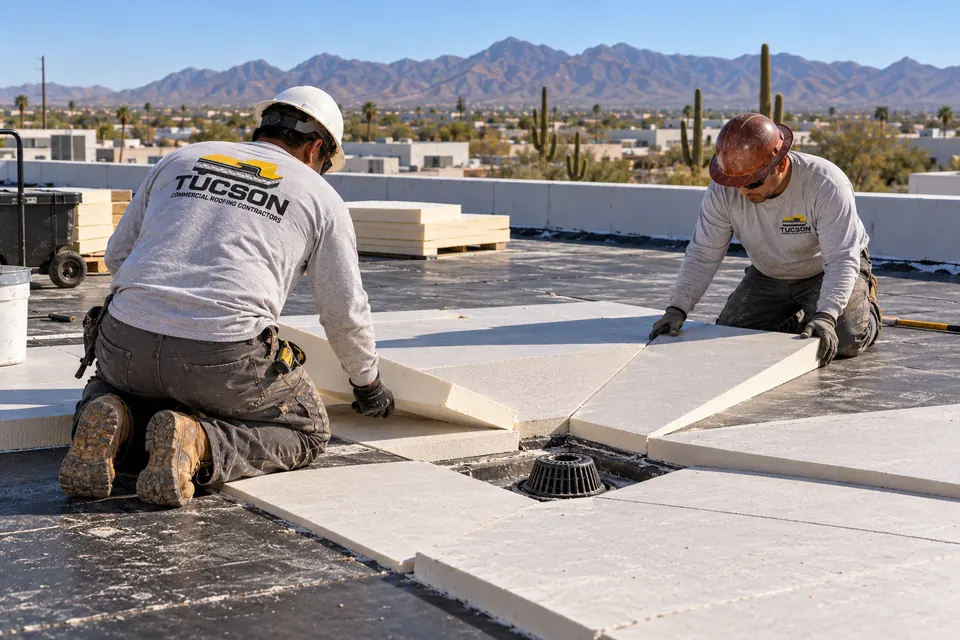
Roofers fitting tapered insulation boards around a roof drain

TPO Roofing

New TPO membrane over tapered insulation and crickets, with welded seams that resist standing water and new overflow scuppers at parapets.

Best forFlat roofs with enough parapet height for added insulation
Look elsewhere ifDecks with severe rust or structural sag
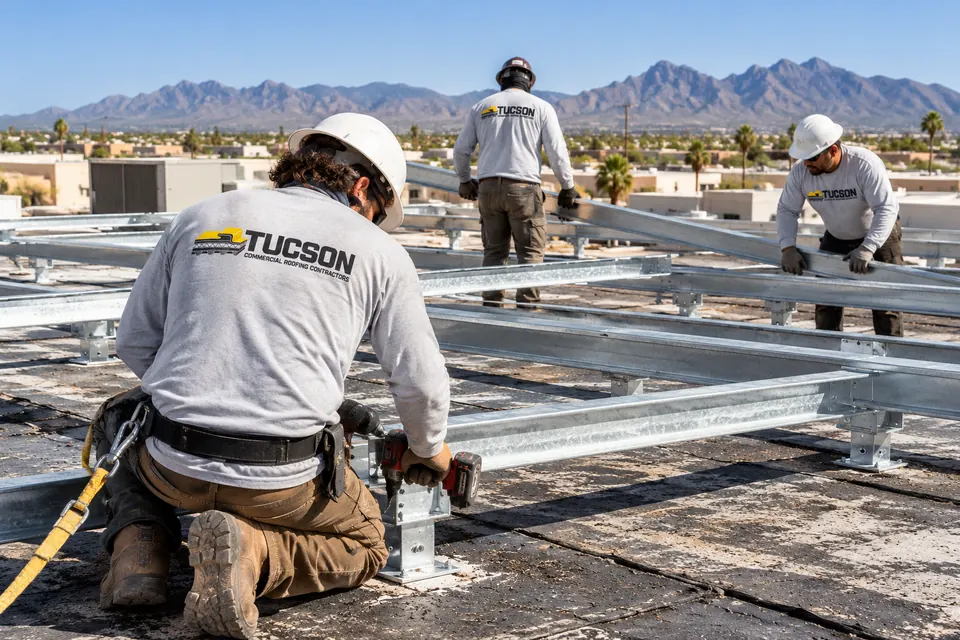
Roofer installing retrofit metal framing over an old flat roof

Commercial Metal Roofing

Light-gauge retrofit framing over the old flat roof carries standing seam panels at a real pitch, sending water to new gutters.

Best forSmall buildings with chronic ponding and low parapets
Look elsewhere ifRoofs crowded with rooftop units and ductwork

Water Sitting On Your Roof After Storms?

Call and tell us where the ponds form, how long they stay, and whether water comes through the ceiling below them.

What To Have Ready

  • Photos of ponds after a storm
  • Drain and scupper locations
  • Building age if known
  • Interior leak spots

How A Flowing Wells Roof Job Runs

This sequence corrects drainage on an older flat roof and replaces the membrane.

  1. INSPECT

    Step 1: Inspect Your Roof

    Each pond is measured for size and depth, and drains, scuppers, parapets, and the underside of the deck are checked for rust and leak stains.

  2. MOISTURE

    Step 2: Find Wet Insulation

    Moisture readings and core cuts around the ponds show how far water has spread under the membrane and which boards need removal.

  3. DESIGN

    Step 3: Lay Out Slope And Outlets

    Tapered insulation layout, cricket locations, and new scupper openings are drawn on a roof plan, or retrofit framing is laid out with pitch to new gutters.

  4. PERMIT

    Step 4: File With Pima County

    Pima County Development Services issues permits for unincorporated Flowing Wells, and inspections are set before the new roof is closed.

  5. TEAROFF

    Step 5: Remove Wet Material

    Old membrane and soaked insulation come off in sections. Rusted deck areas are replaced before new tapered boards and membrane close each section.

  6. WATER

    Step 6: Water Test The Drainage

    After the new roof is installed, we run water on the membrane to confirm it reaches the drains and scuppers, and photos of each outlet go to the owner.

Roofer reading a moisture meter beside a core cut on a flat roof
Roofers removing old roofing in phased sections

Nearby Areas We Serve

Flowing Wells sits on the northwest edge of Tucson, near these communities.

Flowing Wells Commercial Roofing Contractor Questions

Why do flat roofs leak during Tucson monsoon storms?

Flat roofs leak in monsoon storms because heavy rain arrives faster than drains can carry it away. Water rises against seams, flashings, and parapet walls, and any open lap lets it in. Blocked drains and low spots on older decks make the backup worse.

How long can water sit on a flat roof?

Water should drain off within about 48 hours of a storm. Ponds that last longer soften membrane laps, add weight to the deck, and collect dirt that holds moisture. Persistent ponds call for added slope through tapered insulation, crickets, or a retrofit.

What does an overflow scupper do?

An overflow scupper is an opening through the parapet set just above the normal water level at a drain. When the drain clogs during a storm, water escapes through the scupper before it climbs the wall or overloads the roof deck.

Can ponding be fixed without a full replacement?

Small ponds near drains can be corrected with crickets or a tapered insulation patch tied into the existing membrane. Ponding spread across the whole roof, or wet insulation under the ponds, calls for replacement with full tapered insulation to correct the slope everywhere.

When is a metal retrofit better than a new membrane?

A metal retrofit works best on small, simple roofs with chronic ponding and few rooftop units. The framing sets new standing seam panels at a real pitch over the old roof, and well-maintained metal roofs last 40 years or more.

Who issues roofing permits in Flowing Wells?

Pima County Development Services issues permits for unincorporated Flowing Wells. Commercial roof replacements generally require a permit and inspections, and we confirm the jurisdiction from the parcel record before filing, since nearby properties fall inside Tucson city limits.

When should drainage work be scheduled?

Schedule drainage work in late spring so the new slope and scuppers are in place before monsoon season begins June 15. Fall, after September 30, is the next good window, and a post-season inspection then shows which ponds the summer storms left behind.

Get A Free Estimate For Your Flowing Wells Roof

Send photos of the ponds and tell us about the building, and we will set up a roof inspection to measure the drainage.

Call Us (623) 310-0220